
Feb. 9, 2026 - Full Show
2/9/2026 | 26m 48sVideo has Closed Captions
Watch the Feb. 9, 2026, full episode of "Chicago Tonight."
President Donald Trump calls for Republicans to take over elections. And would you ride in a driverless car? Illinois lawmakers push for a self-driving vehicle pilot program.
Problems playing video? | Closed Captioning Feedback
Problems playing video? | Closed Captioning Feedback
Chicago Tonight is a local public television program presented by WTTW
WTTW video streaming support provided by members and sponsors.
Feb. 9, 2026 - Full Show
2/9/2026 | 26m 48sVideo has Closed Captions
President Donald Trump calls for Republicans to take over elections. And would you ride in a driverless car? Illinois lawmakers push for a self-driving vehicle pilot program.
Problems playing video? | Closed Captioning Feedback
How to Watch Chicago Tonight
Chicago Tonight is available to stream on pbs.org and the free PBS App, available on iPhone, Apple TV, Android TV, Android smartphones, Amazon Fire TV, Amazon Fire Tablet, Roku, Samsung Smart TV, and Vizio.

WTTW News Explains
In this Emmy Award-winning series, WTTW News tackles your questions — big and small — about life in the Chicago area. Our video animations guide you through local government, city history, public utilities and everything in between.Providing Support for PBS.org
Learn Moreabout PBS online sponsorship>> Hello and thanks for joining us on Chicago tonight.
I'm Brandis Friedman.
Here's what we're looking at.
A plan to put the Chicago's top financial officials on the hot seat today.
Fizzles.
What we learned about the city's finances at that meeting.
President Trump reignites unfounded claims of election fraud calling for more federal power in state elections.
>> Self-driving cars may be coming to Illinois.
How a pilot program may pave the way for autonomous vehicles.
First off tonight, a push by critics of Mayor Brandon Johnson to put the city's top financial officials on the hot seat.
>> Fizzled today at City Hall as turmoil continues to swirl around the city's finances, acting chief financial officer Stephen Mayor defended the decision to delay part of an extra payment to the city's pension funds.
>> So for 2026, the city, as Mike noted, is dividing the advance pension payment into 2 equal installments.
In an effort to be responsible stewards of the city's cash flow.
The 1st half was paid on January 16th.
And the 2nd half is currently planned to be paid mid year.
>> Or Heather?
Sharon joins us now to break down the latest on the city's budget.
Heather, why did critics of the mayor?
Why did they demand today's hearing before the city's finance committee?
Well, during the city's long just concluded budget season, one of the major sticking points was how much the city was going to pay.
>> Into its pension funds that it's not required to think about it as if you've got a lot of credit card debt and you're trying to pay down that debt by paying more than the minimum payment.
The city's minimum payment on its pensions is nearly 2.8 billion dollars.
And this is designed to send an extra 260 million dollars to that pension fund to prevent the situation from getting even worse.
So why did the city only made half of the required extra payment to the city's for pension funds?
Well, essentially the city didn't have the cash.
The older people hurt today in part because Cook County has been incredibly slow in getting the city and other taxing districts, school districts and libraries, the property tax revenue that they rely on to pay those bills.
And, you know, sometimes you've got a lot bills do on the 15th of the month.
The city has a lot of bills due in January and that created the crash crunch.
This was not budget director and that Guzman and acting fire Chief Financial Officer Steve Marsh said at an effort to thwart the will of the city council has some critics of the mayor had suggested.
So the mayor said last month the city might have to make emergency cuts, including layoffs, if revenue that is big into the city's 2026.
Spending plans fails to materialize.
Do we know whether that's going to be necessary?
We don't know about that city's larger financial picture.
There are still lots of questions about the debt sale ordered by the budget and the gambling in city.
Taverns.
That is also counting on.
So there are still a lot of unknowns, but at least perhaps some answers about the city's pension crisis had Thank you so much.
Thanks.
Brand us.
And you can read Heather's full story on our website.
It is all at W T Tw Dot com slash news.
>> Chicago tonight is made possible in part why the Alexandra and John Nichols family.
The Pope Brothers Foundation.
And the support of these donors.
>> President Donald Trump is re-upping his unfounded claims over voter fraud maintaining the 2020 election was stolen from him in a new escalation.
Trump is calling for Republicans to take over voting in at least 15 yet to be identified.
States and the FBI recently seized election ballots from a center in Fulton County, Georgia, as well as voting machines in Puerto Rico.
This has a new version of a voter ID bill is being considered in the U.S.
House.
Joining us to talk about all of that and more.
Our University of Illinois Chicago law professor Hugh Monday.
And Jacob, Ron executive director of the Cyber Policy Initiative at the University of Chicago.
He's also the former acting principal cyber director under the Biden administration.
Gentlemen, thank you both for joining are so starting with these election fraud concerns, Jake, when it come to you first, is there reason to doubt the validity of the 2020 election?
Absolutely not.
Very simple question.
There's a you know, no reason to doubt it.
Was there and was talk of this country called Russia that did somehow managed to infiltrate our elections.
Remind us what we know about what happened there.
So in 2016, we know that the Russian government scanned multiple voter registration databases throughout the country, including Illinois Cook County was actually one of the first ones to be discovered.
>> We don't have any evidence that they changed any records of votes or deleted people from the files or anything, just that they scanned the files and then stole the data so axle treated the data send it back to Russia and no evidence of them doing anything similar in 2020?
there's no evidence of foreign interference to election infrastructure since 2020 2016 domestic.
correct.
Okay.
>> Hugh, the Constitution specifies that elections are governed by the states that Congress has the right to set laws around the let the elections, is what the president calling for federalizing the elections.
Is that even legally possible?
>> The short answer is is no.
I think this is another attempt by the president to eye sort of undermine public trust in the integrity of elections.
also.
To sort of justify what's going on in Fulton County.
To the extent the search warrant has been as has been within the last few days, should people be concerned or how should we perceive it that the country's director of National intelligence?
>> Is overseeing what's happening in Georgia.
I think we should be concerned.
I think this is an attempt by the president to justify things like the save act, which are less integrity of elections.
Then disenfranchising voters and by making kind of proposals about federalizing elections.
I think he's making more palatable.
The idea of something like the save Act, which which again problematic, even though as you said, Congress does have the ability to pass around state elections.
>> Jake, what is the security benefit to having states administer and govern elections?
There's a series of them.
One of which may be the most important is that.
>> We have multiple.
Jurisdictions is about 8,000 jurisdictions in the country.
Both parties.
Are in office and different states and so on.
And so it's really hard to claim that one party stolen election if both parties are administering elections and 1000 jurisdictions across the country separately, it's really hard for one entity to come in and wholly hack the entire and of election infrastructure for one candidate.
When you get 8,000 little jurisdictions around the country that are administering these elections, Hugh, the Trump administration so far, we know they've sued 20 states and the District of Columbia in a bid to to see those voter rolls.
>> Why are states resistant to him that information over?
Well, again, because this if the Constitution says this is a highly decentralized process and I think states should resist.
I think what we're seeing in terms of the search warrant is an escalation of these attempts because the other >> attempts were civil in nature.
now that the that the FBI's executed a search warrant, any judge has determined that there's probable cause for a violation of federal laws.
It it makes it at point difficult to resist those those those efforts.
And so that's why I think we're seeing that sort of law enforcement piece this process.
>> There's been reporting from Reuters that on the Trump administration investigated Puerto Rico's voting machines citing research as reason for the seizure.
The government's probe did not find evidence of foreign interference.
Jake, why?
Why an investigation at all?
>> Well, it's interesting.
Some of the research they cited was research that we conducted Def Con the world's largest and longest-running hacker conference where we but voting machines and and identified vulnerabilities in those machines.
The vulnerabilities are not new in any way.
These again, we disclose these over a decade ago.
So why they're pointing the specifically right now.
is unclear again, there's vulnerabilities and any mechanical device that exist.
Whether be your toaster, your iPad or a nuclear weapon for that matter.
And so highlighting existence of these vulnerabilities doesn't really suggest to you that there's anything new to to really address.
What does your research show about those vulnerabilities?
What are they woods?
You know, with specifics voting machines so first voting machines are hackable like anything else.
You know, when when the election officials asked the vendors to make voting machines.
They asked him to do 2 things may come cheap and make them able to count votes, not make him able to withstand hacks from, you know, the Chinese government, a ransomware attackers.
And so they are what we paid for.
We pay for cheap devices that can count votes.
But the not very secure.
And so you can get at them remotely.
You can get at them physically and change things but also the software that ties it all together.
It is not secure and that can be accessed the at the Web sites of local election officials.
And so on and can get into the voter registration databases as well as the software, the program's the machine.
So there's a lot of vulnerabilities all throughout the equipment, which is why we've been calling from the beginning too.
Have folks smoke vote on hand marked paper ballots.
That's the number one most secure thing you can do for any voter front elections or 6 in the country.
Have voters spoke on the phone on him, mark paper, ballots secure.
But we also remember hanging chad and other situations from the year 2000, which I think was the catalyst that sort of led to some of the voting systems that we have today.
>> Our paper ballots as reliable when it comes to the villa validity of vote.
Sure.
So there there's been a lot of progress has been made from pregnant chads and dangling chads and dimples and all those things.
>> This can transit exist right now to come to count the paper ballots are our are pretty accurate and certainly as good as anything we had back in the 2000 send and what we sold with tooth out with the Help America Vote Act in 2000 in many ways introduced a whole host of new new vulnerabilities and problems that we're still fixing today.
>> 2, if 50 states.
And I I think Jake mentioned voting districts are voting areas in the country.
Does that not leave room for a lack of equity or fairness, right?
in Illinois, a bunch of us can vote early or not often.
But Illinois, I excuse me.
But in Mississippi, for example, early voting almost does not exist without a very special circumstances.
Is that fair to have this patchwork of of voting systems across the country?
Well, again, I think something like the save act, which is at least reportedly an attempt to standardize some of these pieces is going to result in disenfranchising voters just by putting requirement on that.
Some people simply.
>> Can't beat perhaps by virtue of not having a driver's again, the Constitution is very specific in terms of decentralizing elections and a to the extent that something like early voting exist, I think it it increases access to at the very end of the most local levels that is there is there not room for the federal government to implement something that everyone across the country would have access to?
For example, everybody gets early voting and mail-in ballot and absolutely the federal government could do that if it if it chose.
I think this this notion of this kind of federal takeover.
>> Or or nationalizing elections, whatever that means is far different from Congress coming in creating laws to standardize these processees briefly reporting.
And it found that 58% of Democrats voted by mail in 2020 compared to 29% of Republicans.
The president is also calling to abolish mail-in ballots.
to come back to you.
Security concerns around mail-in voting.
No, fact, it's one of the most secure ways because you're to hand marked paper ballot and you know, those ballots have to get to and to to usually the county, the counts, the ballots one way or another on Election Day.
Somebody takes the polling that box that the ballots are in drives them over the the county to count them.
And with absentees, the Post office So there's not really any infrastructure.
reason why a mail-in voting is any any less secure than voting Mark paper ballot on Election Day.
Can't hack a mail truck, right?
Okay.
You have to go out of your way steal which of course, would be a federal offense.
All right.
That is what we're going leave it.
Human D and Jake Braun, thank you so much.
Thanks for having Appreciate it.
Thanks.
Up next, some Illinois lawmakers are pushing for a pilot program for self-driving vehicles.
That's right.
After this.
>> Self-driving vehicles could be making their way to Chicago and eventually the rest of Illinois, new pilot program being proposed by state lawmakers would allow companies like Waymo to operate in Cook saying a man and Madison counties with autonomous vehicles for 3 years.
The rollout been met with some concerns over safety after the vehicle's past a school bus stop signs in Austin, Texas and struck a child in Santa Monica, California.
Joining us now are running Gonzalez special Representative for I AM Union Midwest territory.
A mechanized union representing workers from different sectors of manufacturing and zoom, Josh McCown ski lobbyist for a beat of Illinois which stands for a Brotherhood aimed toward education.
The organization provides legal resources for motorcyclist in the state and state Representative Kam Buckner whose district includes Bronzeville High Park in the South Loop.
He's sponsoring the bill.
We also reached out to Waymo.
They declined to join us but did send a statement.
We get to that shortly.
Gentlemen, thanks to the 3 of you for joining Representative Buchanan, first.
Why did you propose this legislation?
>> number of reasons, it's what we know that if you look around the country, there's all kind legislation is moving through state houses around U.S.
And what I am really concerned about is making sure that Illinois is ready technology.
If we decide that it needs to come here to the state in a an all inclusive And so what this legislation does is creates a pilot program.
It's a three-year pilot that gives us the opportunity to put a certain number of these cars in the street to figure they love when it comes to safety.
Bigger, what we're doing when it comes to some of that led issues and labor This is little term.
test to see that technology work for Illinois for the future.
>> Josh, what are some of your concerns with autonomous driving vehicles?
Our concerns are primarily with oversight and disclosure of data that so far.
>> Waymo technology has not been independently verified.
And when it comes to oversight on them, the legislation that we've seen pass in other states doesn't allow to recall them off of the roadway.
It doesn't allow for full disclosure is what's going on.
They're demanding access to public roadways to test on against public drivers.
We should have disclosure of the data and we should have oversight.
>> Representative Buckner, would you say to some of those concerns?
>> I think concern you've got make some very good points.
And this is part of I actually believe we have to study.
This is the gives us answer on how we move this technology forward.
If we decide to move the technology forward is very important to know that these vehicles, while swell so driving, they're not so regulating.
We have those conversations, Springfield, about other, do this the right way.
So actually shows extent of anything that happens in this state.
this conversation has to have and safety and privacy its core.
And I hope that we can get there.
>> Renee, you're a leader in the Illinois drivers Alliance.
You're trying to unionize rideshare drivers.
How would the introduction of self-driving cars?
How would it impact your efforts?
Yeah, thank you.
It would definitely have a negative impact immediately to a displace rideshare drivers and our concern and the labor world is that technology has been coming into the workplace for decades now.
And, you know, we'd be foolish to say that it can't, and it's never going to come.
So we want to make sure that drivers have of the waste and are active in legislation if it's going to pass.
>> Is this do you see this as sort of the next sort of progression in this, you know, sort of disruption of transportation, right when LeBron left first came onto the scene, Tad Cabdrivers, taxi drivers were really upset, right?
And then we see far fewer cabs on the road today.
Do you see something similar happening if Waymo or something like it is much more popular?
>> Yes, absolutely.
You know, public transit could suffer rideshare drivers, especially it would have a negative impact.
And those workers, want to participate in the economy of the of the state and they earn money here in the state by giving rides to passengers and they also spend their money here.
If tech company comes in and has autonomous vehicles, those are about taxis are not going to spend their money here in Illinois.
It's going to get siphoned out.
So we want to make sure that it's not a danger to our economy.
There.
>> Representative Buckner, you know, supporters say that this technology, it's the future Illinois could be left behind if the laws are too restrictive.
Do you think there's a way to implement this technology?
But still support the Illinois economy?
>> Absolutely.
Number one witness and this is about not given us past getting this done right.
And I agree with other concerns but making sure that we are not accepting of the labor force in the fact, I have a chief sponsor on the bill that will unionize rideshare drivers here in the state of Illinois are making that get all of these things forward my wheel house here.
But it's important for us to make sure that we're going to where we 29 other states have done But Illinois, second, different posture, right, California tonight to a pilot takes us to pilot Arizona would straight to the point.
We're trying to take our time here and get this right.
And I think we can find abounds.
>> Roni, same question to you.
Would you prefer to not see self-driving autonomous vehicles here altogether?
Or do you think there's a way to bring them here?
But still support the economy?
I think it has to be done responsibly.
And that's what we ask of legislators to make sure that we're not just a test track for them that it's done safely and considers workers positions and that they are not displaced.
While this happens, what might what would that look like upon implementation?
driver transition programs, education, you know, a one for one.
If a driver naturally through attrition, retires out of the market.
That one, you know, autonomous vehicle could replace them.
So.
>> To say it's not going to happen, cool.
It's like I said happens responsibly as what we're looking for.
>> Josh Waymo promotes that their cars are safer than human drivers, which know humans make errors on the road all the time.
We did receive a statement from Waymo.
It reads, quote, Our Technology can make Illinois's roads safer in transportation in the state, more accessible, the data shows our vehicles are involved in 10 times fewer serious injury or worse crashes in 12 times, fewer injury crashes with pedestrians compared to other drivers where we operate.
Josh, what do you make of It because I know that you have concerns over information from Waco.
>> Absolutely.
If you go to Waymo's website, I encourage do it go to safety.
You'll see a phrase that says learn how we choose what date it to include in our reports.
Basically, they cherry pick their numbers.
If you take a look at the numbers that they're reporting first, the numbers that are reported to the National Highway Traffic Safety Administration and the numbers that are being reported in California, it doesn't match.
It doesn't add up.
Additionally, they're using some very curious modeling as to what they determine the vehicle miles traveled by.
Humans would be in making those comparisons.
If you want further proof of how they're modeling a little messed up when they hit the young lady of the young kid in California a couple weeks ago in a school zone, they did a model with a city human driver would have been doing 19 miles an hour through a school zone.
Every human driver.
I know when they see small kids in and out of vehicles slows way, way down.
So there's some serious concerns of how Waymo presents data.
>> What kind of changes, Josh, would you like to see in the proposed legislation?
>> So bay to the Illinois has worked with the co-sponsors to introduce our own version of legislation.
It's House Bill.
4789 Indian or version of legislation.
It requires the public disclosure of every collision that the vehicle has.
It requires identifying numbers on the vehicles.
So when we see those social media posts of Waymo's behaving badly like being stuck on the trolley track, we'll know what unit is messing up.
And then Waymo would have to publicly disclose the unit.
The incident, how it occurred and how they're going to fix it.
And that way you can track the actual progress with real data by unit, by area of operation and maybe those of us that are in traffic safety can all work together to make the product safer overall because right now it's not happening.
10 years of development.
We're still having very serious issues happening on the roadways.
>> Representative Buckner, what protections do you think could be worked into the legislation so that riders and anyone who is not inside the Waymo vehicle, anyone who was around at other drivers and of course, pedestrians, that they are all protected.
>> It's extremely important to me that we get this part right.
We know we have a vulnerable road users who will be sharing the roads with These folks like bicycle.
Listen, motorcyclists and You know, CTA buses will be sharing the with folks.
So we have make sure that we get this right.
I think many of the issues that just bring up a very important that we had find a make sure that folks are protected and that we have process by which to do that.
And is all part of the process is very good that we're having this conversation publicly figure out where we are.
We're doing things that other states have not So truly believe we could all come to the table.
So it kind of eligible for.
>> So just about out of time at a Senate hearing last week, Ronnie chief safety officer for Waymo said that the cars are provided guidance by remote operators with fate.
Don't remotely drive the vehicles.
In fact, some of the operators are in the Philippines.
30 seconds.
Your concerns about that outsourced labor.
>> Yeah.
The fact that a company operating here in the United States and is using outsourced labor obviously is a huge problem.
The fact this company is making money and they're not doing it from American workers and contributing to our economy is just disturbing.
And that's what we'll have to leave it.
I'm sure there's more to come on this issue.
State Representative Kam Buckner.
>> Josh, what Koski and running Gonzalez, thanks to all of you for joining us.
Thank you.
Thanks for having us.
And that is our show for this Monday night.
Stay connected with our reporters and what they're working on by following us on Blue Sky at W T Tw and join us tomorrow night at 5, 30 10.
>> Now for all of us here at Chicago Brandis Friedman, thank you for watching.
Stay healthy and safe and have a good night.
>> Closed caption News made possible by Robert a cliff.
>> And Clifford law offices, a Chicago personal injury and wrongful death.
White the
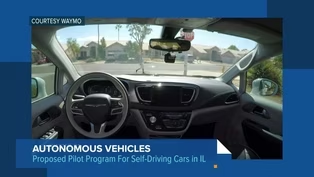
Are Self-Driving Cars Coming to Illinois? Lawmakers Push for Pilot Program
Video has Closed Captions
Clip: 2/9/2026 | 10m 26s | Critics are concerned about how the vehicles will impact rideshare workers and the larger economy. (10m 26s)
Plan to Put City's Top Financial Officials on the Hot Seat Fizzles
Video has Closed Captions
Clip: 2/9/2026 | 2m 44s | Critics of Mayor Brandon Johnson demanded a hearing before the City Council's Finance Committee. (2m 44s)
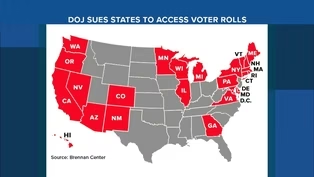
Trump Calls for Federal Oversight in State Elections
Video has Closed Captions
Clip: 2/9/2026 | 9m 50s | President Donald Trump is reupping unfounded claims over voter fraud. (9m 50s)
Providing Support for PBS.org
Learn Moreabout PBS online sponsorship
- News and Public Affairs

Top journalists deliver compelling original analysis of the hour's headlines.

- News and Public Affairs

FRONTLINE is investigative journalism that questions, explains and changes our world.












Support for PBS provided by:
Chicago Tonight is a local public television program presented by WTTW
WTTW video streaming support provided by members and sponsors.