
Here and Now
Here & Now for July 24, 2026
Season 2500 Episode 2504 | 26m 45sVideo has Closed Captions
Watch the entire episode of Here & Now for July 24.
Watch the entire episode of Here & Now for July 24.
Problems playing video? | Closed Captioning Feedback
Problems playing video? | Closed Captioning Feedback
Here and Now is a local public television program presented by PBS Wisconsin
Here and Now
Here & Now for July 24, 2026
Season 2500 Episode 2504 | 26m 45sVideo has Closed Captions
Watch the entire episode of Here & Now for July 24.
Problems playing video? | Closed Captioning Feedback
Where to Watch Here and Now
Here and Now is available to stream on pbs.org and the PBS app.
Providing Support for PBS.org
Learn Moreabout PBS online sponsorship>> The following program is a PBS Wisconsin Original production.
>> We shall see.
Down.
We shall sit down.
>> Protesters take over the streets.
>> We have the power, not that badge.
>> And demand answers from officials.
After a Madison police officer shot and killed a man during an arrest.
I'm Frederica Freyberg tonight on "Here& Now" reaction over the police shooting of Cory Ruiz.
The latest on the race for governor with Marquette Law School pollster Charles Franklin.
Clarity for absentee voters who cast their ballot.
But their candidate dropped out.
And an agency that helped provide people with shelter in ten counties went under.
What happens now?
It's "Here& Now" for July 24th.
[MUSIC] >> Funding for Here and Now is provided by the Focus Fund for Journalism and Friends of PBS Wisconsin.
>> A Madison police officer shot and killed a man as four officers attempted to arrest him this week on Madison's near East Side.
Cell phone video of the altercation quickly went viral.
The community response was swift, demanding answers and action.
Reporter and videographer Marissa Wojcik has more.
But first, a warning to viewers.
This video contains sounds of gunfire.
>> Who died today?
Who was murdered today?
>> Lori.
>> We want the officer's name tonight and we want him arrested.
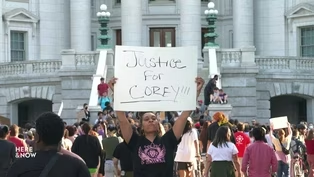
>> Protesters swelled the main traffic artery leading to the state capitol Wednesday.
Soon after, police shot and killed Cory Ruiz during an arrest.
>> We all witnessed on social media last night.
A human being take the life of another human being.
We were all there.
>> Outrage over what online footage showed led community members to disrupt a city press conference and an event at the Capitol.
>> A lot of these places don't even care and what is going on is wrong.
But yet y'all sit here with stale faces.
>> Police say officers responded to a call of a man checking parked vehicles after he attempted to flee.
A physical altercation ensued.
One officer attempted to use a Taser, which failed.
Police say Ruiz injured an officer with a knife before that officer opened fire.
>> When you see someone shot on camera and the shooting happens within a matter of, you know, one, two, three seconds, that is angering and it's horrifying and it's heartbreaking.
>> I want to be clear.
It does not matter who you are or what your past is, you should not lose your life as a result of an encounter with law enforcement.
That should not happen.
>> City officials responded to calls for accountability Thursday.
>> My first thought is when the officer is walking away, why isn't he walking away in cuffs?
That's my first thought.
on George Floyd's neck, and we don't want to hear it today.
That's the.
>> It's really understandable that people want answers right now.
I want them to.
But the honest truth is that good investigations take time.
We have to let the investigation play out.
>> This is an open and active homicide investigation.
Right now.
>> The investigation is being led by the Wisconsin Department of Justice Division of Criminal Investigation.
>> They are hunting us.
They are hunting us.
>> I think everyone in this room can feel the thinness of trust in this city right now, right?
I can feel it.
It did not start yesterday.
And it's not abstract.
It's the direct result, I think, of what our community has gone through and we have watched repeat.
The shooting happened a block and a half from where Tony Robinson was shot and killed by a Madison police officer in 2015.
It happened near the same corner where Paul Heenan was shot and killed by a police officer in Madison in 2012.
So three fatal encounters with police department within roughly 14 years, on the same handful of blocks.
>> This is not new to Madison.
>> This is the third death of a Black man on Willy Street.
This is not new.
That's why when we say no justice, we mean no peace.
>> There is not enough de-escalation.
There are poor training methods, and then there is a tendency to go to the most lethal form of subduing somebody as possible.
When you pull out a gun, someone is going to die.
And we've seen it happen time and time again, and we need that to change.
Now.
>> Many in the community are calling for all officers to wear body cameras.
>> As you know, we don't have a broad deployment of body worn cameras in Madison, and I understand that this fact does create another challenge to repairing trust in our community.
department isn't already deploying them.
>> So the community advocated against implementation of body worn cameras for some years.
And then more importantly, more recently, the community took a different turn and supported body worn cameras.
In the time that I've been on the council, the support for body worn cameras has increased and they'll be funded.
I'm confident that they'll be.
>> Funded.
>> And we're not going to wait for a final report from DC, I to begin the work of examining our policies, our training and response.
We're going to do that now.
>> We'll be here every night until we get justice for the family.
>> There's a collective anger, there's a collective pain there, and there's a collective loss.
>> Is name.
>> For me.
>> Say his name.
>> Reporting from Madison.
I'm Marissa Wojcik for Here and Now.
>> While the State Department of Justice will investigate the shooting, the Dane County D.A.
will make any charging decisions.
The Madison office of the Independent Police Monitor will also investigate.
Turning to election news in the topsy turvy Democratic primary for governor, some insights from this week's Marquette Law School poll.
Even though it was in the field before Lieutenant Governor Sara Rodriguez dropped out, and Milwaukee County Executive David Crowley got back into the race.
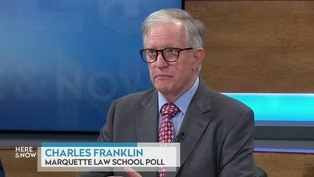
Poll director Charles Franklin is here with more.
And thanks for being here.
>> Thanks for having me.
>> So even in the midst of this upheaval, what are your takeaways from your latest poll?
>> I think the biggest thing is that even with Rodriguez in the race, in our poll, Francesca Hong was still in first place.
That's the fourth poll in a row that she's led.
Mandela Barnes was in second place.
Also the third poll that he's been in second place since he got in the race.
And of course, we didn't have David Crowley because he was not a candidate at that moment.
The other thing that's really important is that 45% of Democratic primary voters said they hadn't decided who they would vote for.
So even before the turmoil of changing candidates, still, almost half of the Democratic electorate said they hadn't settled on who they would support.
>> So Hong's supporters are really strong supporters.
>> They are quite strong.
They're a little more likely to say they're absolutely certain that that's who they're going to vote for.
And when we ask for second choices, she doesn't get that many second choices, which suggests in one sense, that her supporters are already behind her.
But it also suggests that folks that are looking at candidates other than her are not as likely to come to her if their first choice goes away.
>> If two thirds of Democratic voters say winning in November is extremely important, as according to your poll.
How does Tony Evers endorsement of David Crowley factor into that?
>> Thus, the importance of winning in November was uniform.
No matter which candidate you were supporting, all of them gave that high rating to say it was extremely important.
But Evers is remarkably popular among Democrats.
He has an 89% job approval with Democrats right now.
The question is whether his endorsements and activity in the campaign moves people on that decision, as opposed to they like the job he's doing as governor.
But maybe they're not going to be influenced by his recommendations that we really don't know at this point.
>> So the Rodriguez Lane was moderate Democrat who picks up most of her vote.
>> When we asked second choices of people that supported her about an equal number, went to Mandela Barnes and went in, went to Joel Brennan smaller percentage, a good bit smaller, went to Hong and a small percentage went to Kelda.
>> Roys so you described the undecideds at 45%.
Would voters sit this one out and not vote because of all of this confusion?
>> It's possible we do still see a high professed intention to vote.
It certainly won't be the level of a midterm election because primaries are much smaller than that.
But I think the Democratic coalition is pretty well mobilized.
The issue is, does this turmoil in the list of candidates take some people who were in that undecided category and make them just throw up their hands and say, I'm not going to bother or and this is, I think, a real possibility.
It's focusing attention on a race that had been pretty low key up until now.
And so it may have the effect of actually energizing Democratic voters, but we're also seeing a significant split across, especially Hong Barnes and Crowley, potentially Crowley supporters, about how does that split the vote, and does it coalesce around one candidate, or does it just splinter the vote evenly?
>> So even with Hong continuing to lead among Dems, your numbers show Barnes leads Tiffany while the rest of the field does not.
>> That's right.
When we asked the general election question, Barnes is the strongest Democrat, leading Tiffany by four percentage points, whereas Hong trails Tiffany by three points.
When we shift it to likely voters, the people who say they're certain they'll vote in the fall, Barnes lead goes up to five and Hong then ties Tiffany.
So I think my take away from this is that there is a little bit of a differentiation between the candidates, but it's a fairly close race, whether it's Barnes or Hong or any of the other Democrats that we asked about.
So guess what?
It looks like another probably close election in Wisconsin.
>> Yeah.
Does the shakeup at the top of the ticket inform the legislative races?
>> And maybe we asked about who would you vote for for the legislature.
And Democrats had a small lead there about a four point lead.
But that's about just general voting.
We don't ask about individual races there.
I do think that for Democrats chances in the fall, they certainly would benefit from a strong gubernatorial candidate and a winning Democratic campaign, because that support at the governor's level can trickle down to the legislative races.
I think it's way too early to have any sense about whether whoever the nominee is will emerge as a very strong candidate or not.
>> So meanwhile, you're in the field again with a new poll to share with us next Wednesday.
>> Things keep changing, so you have to keep doing new polls.
This poll that will come out next Wednesday is only about Democratic primary voters and only about them.
And we'll certainly ask about opinions of Crowley vote again in the primary.
And also Governor Evers endorsement, and whether people think that makes them more or less likely to support David Crowley.
We will also be re-interviewing the people we've interviewed this past week.
So we'll be able to see whether those undecided folks last week have moved any further towards decision making this week.
The only drawback to this is it's a fairly short period of time, so we'll still have two more weeks to Election Day when this poll is finished.
>> Wow.
Well, thank you for your work.
>> Thank you.
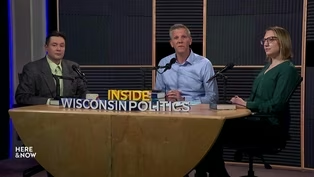
>> For more insights on the twists and turns we look to this week's Inside Wisconsin Politics.
In this excerpt, we hear from our own Zac Schultz and PFAS Shawn Johnson.
>> Of the Democrats in the race right now, not including David Crowley only Mandela Barnes defeats Tom Tiffany in a head to head matchup by a 44 to 40% split among registered voters.
Tiffany leads Francesca Hong 43 to 40%, so a plus four for Mandela Barnes, minus three for Francesca Hong Zac.
I mean, I think it kind of begs the question, why did the establishment not rally around Mandela Barnes?
>> One of the distinctions is Barnes came in with the most name recognition of everyone due to his 2022 US Senate run, his close loss to Ron Johnson.
And it was always a question because he also had the highest negatives that came with that hangover from that election.
And he started running this race as the front runner.
He introduced himself as saying, I'm the one to take on Tom Tiffany.
He did the thing where he ignores the rest of the field and kind of pretends they weren't there.
And then partway through this election, I think he or his campaign realized, oh no, Francesca Hong is there.
I do have to take her seriously.
So we kind of had to shift his tone to talking about his competitors, where I think at first he was running the 2022 U.S.
Senate primary, where all of his competitors dropped out at the end, and he basically had the field to himself.
That didn't happen.
So it is a question of, did the rest of the field say you've had your chance and you couldn't make your case?
Now we're going to go with someone else, or is it simply that they think her negatives are too high, despite the head to head matchup?
Looking good.
>> Why are so many people not sure about this?
What we thought was going to be a very high profile race for governor.
>> Because those 48% make up a lot of people who don't watch this podcast, so they are not as informed.
There are a lot of people who don't pay attention to politics until the very end there.
We just got the first campaign flier in my mailbox this morning.
They're starting to come.
Those people will follow along.
Another thing that happens in primaries pretty regularly is people wait to see if there is a frontrunner.
They don't like to waste their vote on someone who will not win, or they're going to say, well, I like this person, but they're in fourth place and they're not polling very high.
Why would I throw it behind them?
Who is my next favorite?
Which is another good thing that the Marquette poll does is they do.
Who is your next favorite in line?
Another thing to look at is Tom.
Tiffany is unopposed in the Republican primary.
There's still 30% undecided there.
>> Now they're.
>> Finding they're going to vote for the Republican.
But I think you can take that 30%, put it over and compare it to the 48% for the Democrats and go, okay, there's just a lot of people that either aren't tuned in yet, or they're waiting to the last minute to figure out who is actually the frontrunner.
Who do I trust to be the candidate for my my favorite party?
>> You can hear the full episode of Inside Wisconsin Politics wherever you get your podcasts.
A state Democratic Party backed lawsuit seeks to block the Wisconsin Elections Commission guidance that says voters who have returned their absentee ballots cannot request a new ballot if the candidate they voted for drops out.
Candidates like Sarah Rodriguez and Missy Hughes, the elections commission ruled that only a ballot that a voter made a mistake on or is damaged and that they still have in their possession, can be spoiled and returned for a new one.
But that guidance comes after a series of court cases that seem confusing.
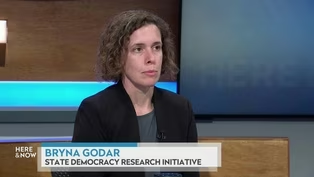
We turn to Bryna Godar, attorney with the State Democracy Research Initiative at the University of Wisconsin Law School, and thanks for being here.
>> So I want to just back up a little bit to set those court cases up.
It was a 2022 lawsuit where a Waukesha County judge ruled that the elections commission had to rescind its guidance, allowing for the spoiling of ballots.
A state appeals court eventually repealed that ruling.
So why don't previous rules allowing casting a new absentee ballot up to three times for any reason prevail under the appeals court repeal of that ban?
>> It's because the appeals court ruling was not actually on the merits.
So they overruled the lower court on this technical procedural issue and didn't reach the merits of what the Wisconsin statute actually requires or allows.
And so that means it's still somewhat ambiguous.
And so the Wisconsin Elections Commission is free to interpret the statute how it thinks is appropriate.
And there are questions of why it switched from its prior interpretation, which is what was challenged in 2022 to what they issued this month.
But essentially, we don't have a court ruling providing certainty on what these statutes mean.
>> How unusual is this circumstance with two candidates dropping out and one reentering, with absentee voting already underway, with like 90,000 ballots already cast.
>> It is something that has come up before where candidates leave the race during this period after absentee ballots go out.
And that is part of why proponents of ballot spoiling think that it should be allowed at this stage is because there are folks who have cast their absentee ballots, and their candidate might no longer be in the race.
>> What about elections Commission guidance to clerks being so close to the August 11th primary?
>> That is another issue that the plaintiffs challenging this change are arguing and pointing to is that voters who return their ballots before that guidance thought that they could potentially then change their ballots after the fact if something developed in the campaigns and at least one voter in the case is saying that he would have held off on submitting his absentee ballot had he known that he couldn't change it at a later date.
>> How could the lawsuit on behalf of these three Democratic voters against that newer guidance upend the election?
>> It could potentially change how clerks are having to handle absentee ballots in the lead up to the election.
So it depends on how quickly a court acts in providing some definitive guidance on this issue.
>> Would it end up then running its course all the way up to the state Supreme Court?
Potentially, potentially.
where the courts would try to act in an expedited manner, and if it did get appealed to the state Supreme Court, they would try to have it act in an expedited way.
quite expedited.
see in something with this short of a timeline, the lower court ruling is the one that stands.
>> So what do you make of the merits of the Democrats lawsuit?
different claims that are being brought.
One is statutory and a couple are constitutional.
And the statutory issue is really reviving the issue that was litigated in the case that we talked about at the beginning of what do Wisconsin statutes actually allow?
And they pretty clearly allow voters to get a replacement ballot if they mess up before returning it to clerks.
There's a lot less certainty on whether the statute allows you to do that.
If you want to change your ballot after you've already returned it, and we still don't have a clear issue or a clear ruling on that issue, the constitutional issues are then raising voting rights claims and equal protection claims, and arguing that if you can't change your ballot after a candidate drops out or you realize later that you've made a mistake, that means that you're not having the opportunity to vote for the candidate of your choice, which is a really important part of the right to vote.
And then the equal protection raises these issues related to the timing of the wet guidance, and some voters potentially having the opportunity to spoil their ballots before that, but not those who cast their ballots later.
>> So what do you make of the merits of the wet guidance.
>> So that guidance is rooted in a circuit court's ruling on this issue in 2022?
So even though that circuit court ruling no longer stands as having the force of law, there was a court that did decide that Wisconsin statutes don't allow for this.
And so WECA is looking to that, presumably in issuing this guidance to be in line with that court case.
>> Pretty complicated.
>> Yes.
>> All right.
Bryna Godar, thank you for spelling it out for us.
>> Thank you.
>> Over one night this week, Wisconsin volunteers fanned out to find the number of people experiencing homelessness in what's called a point in time count.
There are some 5000 people without shelter in the state, and now ten counties in northeast Wisconsin are scrambling to find places for people to stay after a nonprofit provider of homeless services abruptly closed due to bankruptcy, an organization called the Balance of State Continuum of Care, which covers 69 counties in Wisconsin, is rushing in to respond, along with state agencies and other programs.
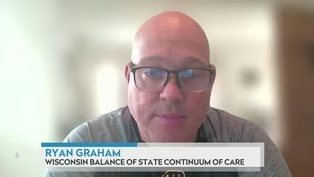
Balance of State homeless systems Manager Ryan Graham joins us now.
And Ryan, thanks very much for being here.
>> Thank you for having me.
>> So how many people served by the bankrupt provider of services are at risk of homelessness in those ten counties?
>> Well, you know, I think there was 134 households that were served in the homeless housing programs that we were we were able to maintain housing for.
But there's a significant amount of homeless folks still in that community that are in need of housing.
And, you know, that lack of services and that closing the closing of that agency really creates a gap in institutional knowledge.
It creates a gap in process and systems and all the things that were established there, you know, in looking for resources and reestablishing that is going to take a considerable amount of effort.
>> Just, just stepping back at at the whole picture is the number of people in Wisconsin experiencing homelessness on the rise?
>> I would say yes.
You know, we just did our point in time count Wednesday.
We are in the process of our post count, meaning we are still up for a week after our point in time count, and we are still looking to engage and identify those folks who are connecting with services.
And that week prior to the council, we can include those folks.
And so that the data is not out yet.
But you know, we haven't fixed the housing problem.
We haven't fixed the lack of services problem.
So and affordability of living just in general has not gotten any better.
So yeah, I do expect the housing problem to increase, not decrease.
>> Because how important is that kind of point in time count toward understanding the needs out there?
>> It's very important.
You know, it's really our only data point that includes folks that are we are engaging with that are sleeping on outside.
So unsheltered or places not meant for habitation, folks that are sheltered, engaged with housing programs, but also our DV population.
And so while we obviously do not locate everybody who's experiencing homelessness in that night or the week prior, we're really comfortable saying it's at minimum, this is what our homeless problem is, and it's a good place to see, see trends, right?
Because of the structure and the way that's been set up consistently for years.
It's a really good data point to look at trends and how homelessness is and how we're responding to homelessness in Wisconsin.
>> Is there enough state, federal and other funding to cover resources needed for this work?
>> Not even remotely.
We are really working hard to do as much as we can with pennies of what we need to do the work, and that takes a collaborative effort.
So we work hard in all of our counties, you know, really to, to build that collaboration and work together to try and problem solve and figure out solutions for people experiencing homelessness.
>> As to federal funding, that point in time, count, I understand, is used to apply for federal grants for housing services.
What kind of uncertainty in that federal funding is there right now?
>> Yeah, I mean, I think there's a significant amount of uncertainty.
You know, I think, you know, looking at the federal Coch program through HUD, you know, they're looking at making significant changes away from permanent supportive housing programs that we know to be effective and moving more towards transitional, non permanent supportive housing, permanent supportive housing or permanent housing efforts.
You know, so I think that's a significant change without protecting the folks that were already housed in these programs.
And so there's a significant shift that is going to provide, I think, a lot of housing insecurity for folks who have who were previously homeless now are securely housed.
And we don't know what that's going to look like here moving forward.
So there's a lot of uncertainty that way.
Graham, thanks very much.
>> Yeah.
Happy to.
>> For more on this and other issues facing Wisconsin, visit our website at PBS wisconsin.org and then click on the news tab.
That's our program for tonight.
I'm Frederica Freyberg.
>> Funding for "Here& Now" is provided by the Focus Fund for Journalism and friends of PBS Wisconsin.
 New
NewBryna Godar on WEC's Ruling on 'Spoiling' Absentee Ballots
Video has Closed Captions
Clip: S2500 Ep2504 | 5m 13s | Bryna Godar on the WEC barring absentee voters from a new ballot if their candidate drops. (5m 13s)
 New
NewCharles Franklin on His Latest Marquette Law School Poll
Video has Closed Captions
Clip: S2500 Ep2504 | 6m 48s | Charles Franklin on his poll showing Hong's strength with her base while trailing Tiffany. (6m 48s)
 New
NewFallout From Fatal Madison Police Shooting of Corey Ruiz
Video has Closed Captions
Clip: S2500 Ep2504 | 5m 12s | Madison Police fatally shot Corey Ruiz, a 38-year-old Black man, prompting protests. (5m 12s)
 New
NewHere & Now opening for July 24, 2026
Video has Closed Captions
Clip: S2500 Ep2504 | 1m 8s | The introduction to the July 24, 2026 episode of Here & Now. (1m 8s)
 New
NewInside Wisconsin Politics: Marquette Polls 2026 Democrats
Video has Closed Captions
Clip: S2500 Ep2504 | 2m 51s | Inside Wisconsin Politics on a new poll on the 2026 Democratic candidates for governor. (2m 51s)
 New
NewRyan Graham on Northeast Wisconsin's Homeless Resources
Video has Closed Captions
Clip: S2500 Ep2504 | 5m | Ryan Graham on filling the gap left by a homelessness assistance nonprofit's closure. (5m)
Providing Support for PBS.org
Learn Moreabout PBS online sponsorship New Episode
- News and Public Affairs

Top journalists deliver compelling original analysis of the hour's headlines.
 New Episode
- News and Public Affairs

Today's top journalists discuss Washington's current political events and public affairs.
 New Episode
 New Episode
 New Episode
 New Episode
 New Episode

 New Episode

 New Episode
Support for PBS provided by:
Here and Now is a local public television program presented by PBS Wisconsin