
January 4, 2026 - PBS News Weekend full episode
1/4/2026 | 26m 45sVideo has Closed Captions
January 4, 2026 - PBS News Weekend full episode
January 4, 2026 - PBS News Weekend full episode
Problems playing video? | Closed Captioning Feedback
Problems playing video? | Closed Captioning Feedback
Major corporate funding for the PBS News Hour is provided by BDO, BNSF, Consumer Cellular, American Cruise Lines, and Raymond James. Funding for the PBS NewsHour Weekend is provided by...
January 4, 2026 - PBS News Weekend full episode
1/4/2026 | 26m 45sVideo has Closed Captions
January 4, 2026 - PBS News Weekend full episode
Problems playing video? | Closed Captioning Feedback
How to Watch PBS News Hour
PBS News Hour is available to stream on pbs.org and the free PBS App, available on iPhone, Apple TV, Android TV, Android smartphones, Amazon Fire TV, Amazon Fire Tablet, Roku, Samsung Smart TV, and Vizio.
Providing Support for PBS.org
Learn Moreabout PBS online sponsorshipLISA DESJARDINS (voice-over): Tonight on PBS NEWS WEEKEND.
As Venezuelans watch, the Trump administration says it's not at war with the country, but clarifies how it plans to use oil to achieve its goals.
Then we explore a new field in medicine that teaches doctors in training ways to prevent diseases through better food.
And how facial recognition, powered by AI is helping scientists track the wide ranging migration patterns of humpback whales.
TED CHEESEMAN, Whale Scientist: Much like a face shows recognition features, right?
The underside of a humpback whale's tail has patterns and shapes and scars that make them individually recognizable.
LISA DESJARDINS: Good evening.
I'm Lisa Desjardin.
John Yang is away.
The world's eyes are on Venezuela.
In Caracas this morning, high tension but relative calm one day after the US military captured Venezuelan President Nicolas Maduro and brought him to the United States for trial on drug trafficking charges and weapons charges.
But profound questions remain, especially after President Trump's repeated statements that the US will be running Venezuela.
On ABC's "This Week," Secretary of State Marco Rubio described a more indirect but intense pressure campaign.
MARCO RUBIO: First of all, what's going to happen here is that we have a quarantine on their oil.
That means their economy will not be able to move forward until the conditions that are in the national interest of the United States and the interests of the Venezuelan people are met.
LISA DESJARDINS: Officials in the Maduro government in Venezuela remain defiant, including interim President Delcy Rodriguez.
But from Trump today, a new threat.
He told the Atlantic she will pay a "very big price, probably bigger than Maduro," if she doesn't do what he thinks is right.
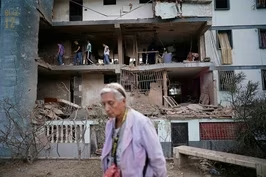
For the tens of millions in Venezuela, a sense of instability.
CECILIA ROMERO, Human Resource Analyst (through translation): We're walking around looking for medicine for food.
There's anxiety and desperation, and we don't know what will happen.
JOAQUIN RESTREPO, retired resident (through translation): We're all living with this uncertainty to see what will happen, what the directives will be so we can continue with life.
LISA DESJARDINS: And we begin our coverage tonight with feature Story News reporter Mary Triny Mena in Venezuela's capital, Caracas.
Mary, how are people coping there today?
And what does that say about where they think things stand?
MARY TRINY MENA: We've been talking to people here in Caracas, and there are two words that comes to my mind, and those are shock and concern because I've been driving around the city looking for pharmacies and supermarkets, and most of them have people lining up to buy some food and medicine and notice because there's a scarcity of product.
Because people believe something more could happen in the coming days.
From the government side, the Maduro governments, the people that remain loyal to Nicolas Maduro, believe that the contract should continue.
The Ministry of Defense of Venezuela, General Vladimir Padrino, said so today.
He said that the country should continue its activities while demanding the release of Nicolas Maduro.
He pledged loyalty to Delcy Rodriguez, which is now the interim president of Venezuela.
LISA DESJARDINS: What do you know about who is in charge there?
And do people believe that the interim government will stand?
MARY TRINY MENA: Well, they have the support of Venezuela security forces.
So as long as the high ranking officials are supporting the government of Delcy Rodriguez, the country is run by most of them.
If you walk in the streets of Caracas, you will see checkpoints, you will see police officers and members of different agencies of the government verifying that everything is staying calm.
So when you feel that and you feel that they are in control of the domestic flights, the border, you tend to believe that they are in control of the situation.
Really the city is in calm.
There are some demonstrations in favor of Maduro and some other people that decided to really stay at home and weigh what will happen in the coming days.
LISA DESJARDINS: Mary, our last question in the last few seconds, do you have a sense of how people there view the United States right now?
MARY TRINY MENA: I've been asking that too.
And when you ask about the outcome of the operation, some people say that it was unfair that the US attacked Venezuelan soil making or posing risk on Venezuelans, not only on the authorities they were looking for.
And some other people prefer not to respond that question because they say they have fears of reprise from the government.
We need to remember that Venezuelans are living under an authoritarian regime and there's censorship in the country.
There are TV stations that are not broadcasting the events, just the message coming from the Maduro government and his loyals.
LISA DESJARDINS: Mary Triny Mena, thank you so much.
MARY TRINY MENA: Thank you for having me.
LISA DESJARDINS: In Washington, divisions are deepening over President Trump's actions in Venezuela.
On Fox News Sunday, Homeland Security Secretary Kristi Noem called the move necessary.
KRISTI NOEM, Homeland Security Secretary: We have been building a case against Maduro for years.
Homeland Security investigations, along with the FBI and the CIA have been tracking his drug trafficking, his crimes against humanity right here in the United States.
And to see him brought to justice is incredibly satisfying.
LISA DESJARDINS: But Senate Minority Leader Democrat Chuck Schumer said the goal does not justify the means.
CHUCK SCHUMER, Senate Minority Leader: Maduro's a horrible, horrible person but you don't treat lawlessness with other lawlessness.
When America tries to do regime change and nation building in this way, the American people pay the price in both blood and in dollars.
LISA DESJARDINS: For more understanding, we turn to Silvia Pedraza from the University of Michigan, who has studied Venezuela and its vast diaspora.
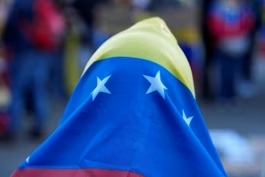
Silvia, you've been watching Spanish language news, including from Venezuela, how's the Latin American world viewing this?
SILVIA PEDRAZA, University of Michigan Professor: Well, I think that any authoritarian regime, whether of the left or the right, creates a lot of opposition.
And some of that opposition leaves the country.
There is a massive exodus that takes place.
Some of it ends up in prisons if they are politically active, and some of it just tries to remain focused on their family, their own lives and to keep it at the margins.
So I think that most Venezuelans are actually very happy with this outcome.
They did their best by holding very fair, true democratic elections in July 2024 and that got them nowhere because Maduro did not acknowledge the results of the elections and he pretended that they were false, though the democratic opposition had a lot of data showing that they were true.
This is the only possible outcome, really.
It's not one that I think that most people would have preferred.
But I think Venezuelans are very happy because they realized that they had done everything that they could, and that this was the only solution left.
LISA DESJARDINS: President Trump is focused on now Interim President Delcy Rodriguez.
The Supreme Court essentially put her in that position.
Yesterday he praised her, today he threatened her.
He has ignored pointedly, the opposition leader, Maria Corina Machado.
How wide is her support do you think?
And what do you see if Trump tries to freeze her movement out altogether?
SILVIA PEDRAZA: Well, I think that's not possible.
I think that Trump has to work with Maria Corina Machado and Edmundo Gonzalez, the elected president at the parliamentary elections.
I think he needs to work with them and also with the exile.
There is a significant exile from Venezuela.
Eight million people have left, 4 million are in Colombia, over a million and a half are in the United States, Peru, Ecuador, Brazil, lots of countries in the region have Venezuelans.
And some of them will want to return and to be part of the process of reconstruction.
So there needs to form a sort of a roundtable, using the Polish analogy, in which you have Trump and the United States and its interest.
Corina Machado and the president elected and also representatives of the exile community, and all three of them together need to reconstruct the country and to restart it, and not just the United States.
LISA DESJARDINS: You know, as we just heard, there are mixed views of the United States right now.
Some of those surround widespread spread concern.
In the view of one person who texted me that the United States is there to just plunder the oil reserves there.
Others say, no, China has had too much influence, that Venezuela has been the puppet of China and the US has to intervene.
Can you help us with that debate right now over the US as well -- SILVIA PEDRAZA: Well, that's very big.
But I think that, you know, the available data to me, I sat and watched President Trump's speech.
In the beginning, he talked about the reasons behind the US intervention being related to the narco traffic and the drug trade that came from Venezuela to the United States.
He spent some time of that.
Then he very briefly mentioned democracy.
It was remarkably brief.
And then, he spent a lot of time talking about the oil reserves that had been part of the United States and the need for the United States to now update them and refurbish them because they were in such sorry shape, and that this would benefit not just the United States, but the Venezuelan people.
So I think that he himself has told everybody that for him, the most important issue was the oil issue.
However, for the Venezuelan people who are on the streets, clearly for them, the major issue is democracy.
LISA DESJARDINS: I want to play some sound from Secretary of State Marco Rubio today.
He's addressing concerns that the US is in over its head here, that the US Is taking on too much risk.
Here's what he said.
MARCO RUBIO: The whole, you know, foreign policy apparatus thinks everything is Libya, everything is Iraq, everything is Afghanistan.
This is not the Middle East.
And our mission here is very different.
This is the Western Hemisphere.
LISA DESJARDINS: The US has quite a history in Latin America.
There are real concerns about risks to the United States intervention here.
How do you see those risks in our last 30 seconds or so?
SILVIA PEDRAZA: I think that there is a risk to returning to the Monroe Doctrine of America from, for the Americans, meaning for the United States and not for the whole Western Hemisphere, which is what it should be.
And I go back to my point that I want to emphasize that what needs to happen for a process of reconstruction in Venezuela is for a roundtable of the United States, the exile community, and the democratically elected organized community in Venezuela to come together and together work out a program of reconstruction.
LISA DESJARDINS: Silvia Pedraza, we thank you for your thoughts.
SILVIA PEDRAZA: Thank you.
Thank you for inviting me in.
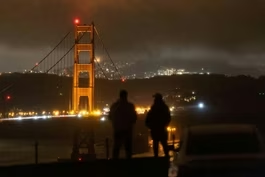
LISA DESJARDINS: Tonight's other news, parts of Northern California are bracing for more rain as residents try to escape rising floodwaters.
A combination of heavy rains and so-called king tides have led to dangerous driving conditions this weekend.
Several drivers had to be rescued from their cars in Marin County, just north of San Francisco.
King tides happen when the sun, moon and earth align in a way that brings tide levels to their highest.
More rain is expected across Northern California through Monday, which the National Weather Service says could lead to flash flooding.
Overseas now, hundreds gathered to attend a church service and memorial for those killed in a New Year's Day fire in Switzerland.
People packed a local church and formed a procession to the makeshift shrine built for the victims.
At least 40 people were killed and more than 100 others injured when a fire erupted in a bar in the early hours of New Year's Day.
Swiss authorities announced this weekend they have opened a criminal investigation into the bar's managers after a preliminary investigation showed sparklers in champagne bottles likely caused the deadly blaze.
Moving to Nigeria, where gunmen killed at least 30 people and abducted several others.
It happened overnight in a small village in the northern part of the country, near the area where 300 school children were kidnapped in November.
The gunman stormed the village, opened fire on residents and razed the local market and houses.
Armed rogue gangs in Nigeria often target remote communities that don't have extensive security or government presence.
Still to come on PBS NEWS WEEKEND, a new approach to teaching medicine by teaching future doctors more about food and how cutting edge AI is leading to insights about ancient species, humpback whales.
LISA DESJARDINS: We are what we eat, so the saying goes.
That age old wisdom is behind the emergence of a new field in medicine.
Ali Rogin brings us this report at the intersection of arts and health as part of our Canvas Series.
WOMAN: Today we are going to be cutting a whole bunch of things.
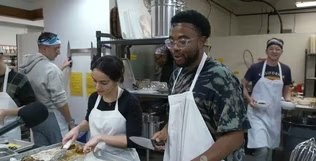
ALI ROGIN (voice-over): In this professional grade kitchen, class is in session but it's not culinary school and these students aren't chefs in training.
In fact, some say they hardly cook at all.
WOMAN: We have a few squashes.
This is a spaghetti squash.
ALI ROGIN (voice-over): They are third and fourth year medical students taking the Culinary Medicine Elective at George Washington University.
It's a growing field that combines the art of cooking and the science of medicine with the goal of improving patients' health through food.
TIMOTHY HARLAN, GWU Culinary Medicine Program Executive Director: We take all of that information that we learn in the first two years, the pre-clinical years of medicine, biochemistry, physiology, metabolism, et cetera, and translate that into the conversation that you can have in the examination room with your patient about food.
ALI ROGIN (voice-over): Dr.
Timothy Harlan is the Executive Director of the Culinary Medicine Program here.
TIMOTHY HARLAN: Come on, I'll show you.
ALI ROGIN (voice-over): As a med student he wrote about the link between food and health for cardiovascular patients.
Later, while working at Tulane Medical School, he set up a teaching kitchen.
TIMOTHY HARLAN: For a while we worked out of an ad hoc kitchen at Tulane and we would go out to community centers, but then dean's offices and universities see how valuable it is.
ALI ROGIN (voice-over): He says, the value is in empowering doctors to talk to their patients about food.
Only a small percentage of physicians say they feel comfortable doing that, even though diet related illnesses like heart disease and diabetes are among the leading causes of death in the United States.
Now, the idea Dr.
Harlan first started thinking about as a med student is taking off.
Culinary medicine programs are spreading across the country.
There are more than 60 medical schools, residency programs and nursing schools adopting Harlan's Health Meets Food curriculum.
He believes it's essential, especially as there's a growing recognition that the tools for fighting and preventing disease are not always found in the medicine cabinet.
TIMOTHY HARLAN: Pharmaceuticals, medical devices, surgery interventions are phenomenal, absolutely phenomenal.
But there's been a concomitant rise in calorie dense nutrient poor food that has led to food related illness at a very high rate.
ALI ROGIN (voice-over): Right now food is also on the political front burner Health and Human Services Secretary Robert F. Kennedy Jr.
says he wants all medical schools to provide nutrition education.
ROBERT F. KENNEDY JR, Health and Human Services Secretary: We can reverse the chronic disease epidemic simply by changing our diets and lifestyles.
But to do that, we need nutrition to be a basic part of every doctor's training.
ALICIA TUCKER, GWU Culinary Medicine Education Director: All of this is very pertinent to diet and nutrition, right?
ALI ROGIN: Dr.
Alicia Tucker is George Washington University's Director of Culinary Medicine Education.
She believes this program can play a critical role in educating the next generation of doctors.
ALICIA TUCKER: These students have a lot of really important basic science to put in their brains.
But we also know that historically nutrition has sort of fallen by the wayside in a lot of curriculum development.
I think culinary medicine provides a really unique opportunity to not only increase that fundamental nutrition knowledge, but do it in a really practical hands on and fun way.
ALI ROGIN: What are you making today?
MAN: We're making a spaghetti squash pasta and our friend Alex over here is making a healthy smoothie and banana rolls.
ALI ROGIN: Do you think everything you've learned in this class is going to help you in your medical career?
MAN: Everyone eats food, so I think this can be a conversation held with every single patient that we see in the future.
We're plating our hidden veggie burgers right now.
ALI ROGIN (voice-over): Charles Cobbs is a 4th year medical student training to be a surgeon.
CHARLES COBBS, Medical Student: I think that this class has so much value fun with my friends, get to cook every day, get a free meal, but also just gaining skills of learning about what's going into my patients bodies.
ALI ROGIN (voice-over): That awareness alone can enhance a patient's experience, says Chief Instructor and Dietitian Jennifer Leon.
JENNIFER LEON, GWU Culinary Medicine Program Chief Instructor: So when patients come in and get their lab results at their primary care appointments and they don't know what to do next, it's not super helpful to hand a diet and say, here, do this.
And it's much better to relate to your patients and say, I understand how hard it might be to make whatever changes.
This is how I learned it.
ALI ROGIN (voice-over): We saw how they learned it first through cooking and then through eating and talking.
JENNIFER LEON: Can you take a look and see how much fiber was added to that cauliflower mac and cheese?
ALI ROGIN (voice-over): Making connections between ingredients and preparation, and health benefits that one day they might share with patients.
(on camera): This is culinary medicine on a plate.
Everything here was prepared from scratch using simple fresh ingredients.
Super nourishing and everything tastes delicious.
(voice-over): But it's also clear that for these students, this class isn't just a diversion.
It's a chance to think differently about their chosen profession in medicine.
CHARLES COBBS: Of course, you can prescribe so many different things, but there's so much that goes into someone's health that is outside of the hospital.
And so as a doctor, understanding what people are putting into their bodies and how it can affect their health just makes you a much more well-rounded physician.
I think that's something that I really aspire to be.
So, yes, a lot of value in this class, that's for sure.
ALI ROGIN (voice-over): Because the cure to what ails us isn't always found in the hospital, sometimes it's right in the kitchen.
For PBS NEWS WEEKEND, I'm Ali Rogin.
LISA DESJARDINS: Humpback whales are some of the largest creatures on earth and live in every one of the planet's oceans.
Their seasonal migrations are among the longest of any mammals, stretching thousands of miles.
Now scientists are using AI powered facial recognition to track them on their journeys.
Here's John Yang with his encore report.
JOHN YANG (voice-over): Even though adult humpback whales weigh as much as 40 tons and measure up to 60ft long, that's longer than a school bus, they can be dwarfed by the vast open waters of the oceans.
For decades, scientists tracked them by comparing photographs of their distinctive tails.
Marine biologist Ted Cheeseman TED CHEESEMAN: Much like a face shows recognition features, right?
The size of my nose, the size of my chin, all that sort of thing.
Underside of a humpback whale's tail has patterns and shapes, and scars that make them individually recognizable.
JOHN YANG (voice-over): Sifting through the thousands of photographs from a month long research voyage could take up to a year.
So Cheeseman turned to image recognition technology to do the same thing in about two days.
He built a website called Happy Whale where photographs can be uploaded and analyzed.
To date, scientists and the general public have submitted more than 1 million photos, creating a global catalog of more than 100,000 individual whales.
Each new data point provides more insight into the whale's movements.
TED CHEESEMAN: It's hard to grasp the scale of a whale or creature that can just casually swim from Alaska to Mexico, or Hawaii every season just to find a mate, and then swim back and not feed the entire time, three, four months without eating at all.
That's pretty hard to grasp.
But this gets us a little closer to being able to see that.
JOHN YANG (voice-over): Researchers discovered that a whale first seen in 2013 off the coast of Colombia in South America was spotted nine years later on the other side of the globe, near Zanzibar off eastern Africa.
Tourists flock to the waters where whales congregate for a glimpse of these awesome creatures.
CECILIA CRUZ, Proyecto Cetaceo Co-Founder: Sometimes they're just like breathing and we're all like, you know, and they're just like, poof.
And we're like, oh, my gosh.
JOHN YANG (voice-over): Cecilia Ruiz runs whale watching expeditions in Cabo San Lucas, Mexico.
CECILIA RUIZ: They are super important for our oceans and they're super important for just the planet health in general.
I feel like we are sometimes disconnected with nature, with living our regular lives.
JOHN YANG (voice-over): She uses Happy Whale to tell her clients the stories of the whales they see.
CECILIA RUIZ: If you tell them like, oh, this specific whale came here, had their baby, and then they saw them in Canada, and then you tell them these stories.
And I feel like people engage more with the whales and see them more as individuals other than just animal that is migrating.
JOHN YANG (voice-over): She calls it Facebook for whales.
CECILIA RUIZ: I get notifications still like, hey, the whale you saw on January, it's now here, you know?
JOHN YANG (voice-over): About a third of the images on Happy Whale are contributed by the public.
Earlier this year, a tourist on a whale watching cruise in Hawaii uploaded a photograph of what turned out to be the world's oldest known humpback whale.
Called Old Timer, the male was first identified by a scientist in 1972, making him at least 53 years old.
Crowdsourcing whale tracking has been a boon for scientists like Ted Cheeseman.
TED CHEESEMAN: We're able to actually see, thanks to the public's involvement, quite a lot more resolution with the science.
JOHN YANG (voice-over): With it, they can monitor how whales are coping with the threats posed by warming seas, being struck by ships and entangled in long lines used by commercial fishermen.
Scientists use that information to model population growth and even estimate the survival rate of individual whales.
Commercial whaling decimated the humpback whale's population in the 19th and 20th centuries.
It's recovered thanks to conservation efforts, which can be supported by the data Happy Whale generates.
And Cheeseman says the public awareness the website generates is a benefit in itself.
TED CHEESEMAN: We published a lot of research papers as a result of the data that's flowing through this, and I think that's really meaningful and worthwhile.
But I think the publicly engaging side of it, the fact that this brings us closer to a very impressive and rather magical and hard to understand element of the natural world, is probably what I'm most proud of.
LISA DESJARDINS: And that's it for our 30 minute long program for tonight.
I'm Lisa Desjardins.
For all of my hard working colleagues, thank you for joining us and have a good week.
How culinary medicine fights diseases through better food
Video has Closed Captions
Clip: 1/4/2026 | 5m 53s | Emerging field of culinary medicine helps fight diseases through better food (5m 53s)
News Wrap: Heavy rains, king tides threaten California
Video has Closed Captions
Clip: 1/4/2026 | 2m 2s | News Wrap: Heavy rains, king tides create dangerous conditions in northern California (2m 2s)
U.S. intervention in Venezuela sparks mixed views worldwide
Video has Closed Captions
Clip: 1/4/2026 | 6m 37s | Trump’s intervention in Venezuela sparks mixed views of U.S. around the world (6m 37s)
Venezuelans face uncertainty while awaiting next U.S. moves
Video has Closed Captions
Clip: 1/4/2026 | 4m 30s | Venezuelans face uncertainty while awaiting Trump’s next moves with the country (4m 30s)
Providing Support for PBS.org
Learn Moreabout PBS online sponsorship
- News and Public Affairs

FRONTLINE is investigative journalism that questions, explains and changes our world.

- News and Public Affairs

Today's top journalists discuss Washington's current political events and public affairs.










Support for PBS provided by:
Major corporate funding for the PBS News Hour is provided by BDO, BNSF, Consumer Cellular, American Cruise Lines, and Raymond James. Funding for the PBS NewsHour Weekend is provided by...