
Degree in three: More colleges speed up graduation timelines
Clip: 5/19/2026 | 8m 14sVideo has Closed Captions
Degree in three: Why more colleges are speeding up graduation timelines
Only about a third of Americans now believe a four-year college degree is worth the cost. Increasingly, students and families are questioning it too. As many colleges across the country face shrinking enrollment, more than 60 institutions are now offering students a faster path to graduation. Fred de Sam Lazaro reports as part of our series, Rethinking College.
Problems playing video? | Closed Captioning Feedback
Problems playing video? | Closed Captioning Feedback
Major corporate funding for the PBS News Hour is provided by BDO, BNSF, Consumer Cellular, American Cruise Lines, and Raymond James. Funding for the PBS NewsHour Weekend is provided by...
Degree in three: More colleges speed up graduation timelines
Clip: 5/19/2026 | 8m 14sVideo has Closed Captions
Only about a third of Americans now believe a four-year college degree is worth the cost. Increasingly, students and families are questioning it too. As many colleges across the country face shrinking enrollment, more than 60 institutions are now offering students a faster path to graduation. Fred de Sam Lazaro reports as part of our series, Rethinking College.
Problems playing video? | Closed Captioning Feedback
How to Watch PBS News Hour
PBS News Hour is available to stream on pbs.org and the free PBS App, available on iPhone, Apple TV, Android TV, Android smartphones, Amazon Fire TV, Amazon Fire Tablet, Roku, Samsung Smart TV, LG TV, and Vizio.
Providing Support for PBS.org
Learn Moreabout PBS online sponsorshipGEOFF BENNETT: Only about a third of Americans now believe a four-year college degree is worth the cost.
And, increasingly, students and families are questioning it too.
As many colleges across the country face shrinking enrollments, more than 60 institutions are now offering students a faster path to graduation.
Fred de Sam Lazaro reports as part of our series Rethinking College.
FRED DE SAM LAZARO: At Johnson & Wales University in Providence, Rhode Island, signs of a typical spring are everywhere.
(CHEERING) FRED DE SAM LAZARO: The graduating class is honored as they prepare for their next stage in life.
Some students play catch on campus green space, while others, like sophomore Jadyn Stuart, begin shifts at summer jobs.
JADYN STUART, Student, Johnson & Wales University: I felt like I needed to be in hospitality, and that's kind of why I went here because I knew it's what I wanted to do.
FRED DE SAM LAZARO: Stuart, a hospitality management major, represents something entirely new at Johnson & Wales, however.
After transferring from the University of Maine last fall, Stuart became part of an inaugural class of more than 90 students now on track to graduate with a bachelor's degree in three years.
JADYN STUART: Even though it's three years, I'm still taking the classes that I need to take.
I'm still doing the work that I need to do.
And, yes, I'm taking major-specific courses with less electives, but there's still going to be specific to what I need to do in the work force.
FRED DE SAM LAZARO: Freshman Katie McPartlin is also a three-year student majoring in criminal justice.
KATIE MCPARTLIN, Student, Johnson & Wales University: None of the schools I applied to offered that, and I think it was a big factor in coming here, because I really just want to work in the field as soon as I can and get the internships and get the experience.
FRED DE SAM LAZARO: McPartlin hopes to one day work as a forensic psychologist interviewing and advocating for victims of crime.
She says, for most students who pay around $45,000 a year in tuition, there's an immediate benefit to the three-year degree.
KATIE MCPARTLIN: The most obvious and universal benefit is that you save the tuition.
And then, for myself, I think it is being able to take the classes that I want that are targeted towards criminal justice students that really help you get engaged into what you will be going into.
FRED DE SAM LAZARO: Provost Richard Wiscott designed the three-year curriculum at Johnson & Wales, a university that now serves more than 8,000 students on two campuses.
He says the idea was to start by offering three-year degrees in fields with an immediate need for qualified workers.
RICHARD WISCOTT, Provost, Johnson & Wales University: The traditional four-year model is around 120 academic credits.
We have designed our programs to be between 90 and 94 to 96 credits, but that can still be completed in six academic semesters, so three years.
FRED DE SAM LAZARO: Wiscott says the three-year model also represents a much-needed rethinking for Johnson & Wales, whose student enrollment has dropped by about a third over the last decade.
The university was also forced to lay off more than 90 employees last year.
Across the country, more than 300 colleges have closed since 2008.
RICHARD WISCOTT: Higher education is in time of crisis right now.
Public perception is lower than it's ever been.
People are struggling to find the value in a college education.
Tuition increases year after year after year.
Families can't do it anymore.
And so we have a responsibility to look at creating new ways of educating our students.
FRED DE SAM LAZARO: The degree in three is rapidly gaining acceptance in the world of higher education.
Dozens of universities across the United States are now either offering it or planning to offer the option to students.
LORI CARRELL, Chancellor, University of Minnesota Rochester: There is nothing magical about four years.
FRED DE SAM LAZARO: Chancellor Lori Carrell says the three-year degree was rolled out during the pandemic at the University of Minnesota Rochester.
LORI CARRELL: Look at the statistics across the country of how many students take six years to do the four-year, of course, making it way more expensive.
And we cannot say that we're being successful.
FRED DE SAM LAZARO: This campus, which opened in 2009, has created a pipeline for the rapidly growing Mayo Clinic.
Half of all graduates across health care fields begin their careers here.
Its 1,100 students get paid internships and training alongside leading medical professionals, all while completing their undergraduate degrees one year earlier.
What did you presumably cut out and how did you compensate for that?
LORI CARRELL: Nothing was cut out, but the design was to use summer to embed paid internship that was a yearlong and have that supported in such a way that it was credit-bearing and to teach the courses in seven-week blocks, rather than the traditional 14-week semester.
FRED DE SAM LAZARO: That means three-year students like Vaida Goplin still graduate with the traditional 120 credits.
VAIDA GOPLIN, Student, University of Minnesota Rochester: More students would come to these four-year universities if these three-year programs were offered or even advertised a little bit more, just because you do save a whole year.
And you save a whole year of time and money as well.
FRED DE SAM LAZARO: Goplin's three-year degree, which she completed this month, also guarantees her a spot in a master's program at UMR to become a physician's assistant, she hopes at the Mayo Clinic.
VAIDA GOPLIN: I am a big planner.
And to have kind of that peace of mind that I would be accepted into P.A.
school right out of high school was, like, just an absolute selling point for me.
VISHNURAM BALASUBRAMANI, Student, University of Minnesota Rochester: I think I will miss the flexibility of being a college student.
FRED DE SAM LAZARO: Vishnuram Balasubramani is about to graduate after three years, and he already has a paid job as a research technologist at Mayo.
He plans to eventually go to medical school.
And yet, he says, there are drawbacks to the faster pace.
VISHNURAM BALASUBRAMANI: I do wish I had the opportunity to stay for much longer.
I find being a college student opens up a lot of opportunities.
And so being on a three-year path kind of puts you on a limited time mode, and so you kind of have to suck up as many opportunities as possible.
And so I think that's a disadvantage of graduating in three years, which I have recognized now.
FRED DE SAM LAZARO: Critics also warn that losing a year cuts classes designed to expand students' world views and leaves them ill-prepared for a job market now being reshaped by artificial intelligence.
But back at Johnson & Wales, provost Richard Wiscott is optimistic, even though he admits questions still remain about how both employers and graduate schools will view three-year degrees.
RICHARD WISCOTT: I'm the first one to admit we still need to collect the evidence to make sure that we are adequately preparing these students.
But we have done the right planning and the right thinking, and everybody had enough positive things to say about this that it gave us even more energy to move forward.
FRED DE SAM LAZARO: Moving forward, Wiscott says he expects Johnson & Wales to start offering more students in more majors the opportunity to pursue a three-year degree.
But that doesn't mean he believes it'll be a silver bullet for all students, especially ones who might need more time in college to decide on a career path.
RICHARD WISCOTT: I am not advocating that three-year degrees should replace all four-year degrees.
I think there is enough space in the marketplace for both options.
But there's a whole other group of students who are very focused, who know what they want to do at their life, who don't want to spend the time exploring.
They want to jump right into their chosen field of study, get as much experience as possible, and be prepared to hit the job market running.
FRED DE SAM LAZARO: A volatile job market that universities are trying to keep up with, as they determine how best and how long to prepare their students.
For the "PBS News Hour," I'm Fred de Sam Lazaro.
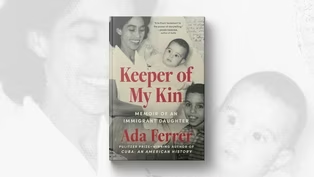 New
NewAda Ferrer reflects on family history, forces shaping Cuba
Video has Closed Captions
Ada Ferrer reflects on family history and forces shaping Cuba and the U.S. in new memoir (8m 49s)
 New
NewEPA moves to roll back limits on PFAS in drinking water
Video has Closed Captions
Trump administration moves to roll back limits on forever chemicals in drinking water (4m 48s)
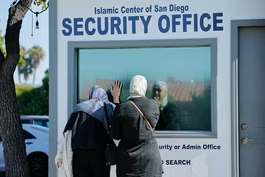 New
NewMosque attack heightens fears as anti-Islam rhetoric rises
Video has Closed Captions
San Diego mosque attack heightens fears as anti-Islam rhetoric rises in U.S. (9m)
 New
NewNews Wrap: Government to drop tax claims and audits of Trump
Video has Closed Captions
News Wrap: Government to drop tax claims and audits of Trump (8m 5s)
 New
NewRussian exiles stage fresh take on classic play in U.S.
Video has Closed Captions
Russians who fled after Ukraine invasion stage fresh take on classic play in U.S. (7m 34s)
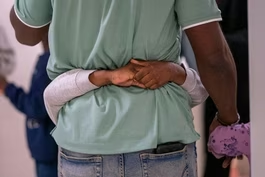 New
NewWhat happens to children when parents are detained by ICE
Video has Closed Captions
What happens to children when immigrant parents are detained by ICE (5m 49s)
Providing Support for PBS.org
Learn Moreabout PBS online sponsorship
- News and Public Affairs

Today's top journalists discuss Washington's current political events and public affairs.

- News and Public Affairs

FRONTLINE is investigative journalism that questions, explains and changes our world.












Support for PBS provided by:
Major corporate funding for the PBS News Hour is provided by BDO, BNSF, Consumer Cellular, American Cruise Lines, and Raymond James. Funding for the PBS NewsHour Weekend is provided by...