
September 14, 2026 - PBS News Hour full episode
9/14/2026 | 57m 46sVideo has Closed Captions
September 14, 2026 - PBS News Hour full episode
September 14, 2026 - PBS News Hour full episode
Problems playing video? | Closed Captioning Feedback
Problems playing video? | Closed Captioning Feedback
Major corporate funding for the PBS News Hour is provided by BDO, BNSF, Consumer Cellular, American Cruise Lines, and Raymond James. Funding for the PBS NewsHour Weekend is provided by...
September 14, 2026 - PBS News Hour full episode
9/14/2026 | 57m 46sVideo has Closed Captions
September 14, 2026 - PBS News Hour full episode
Problems playing video? | Closed Captioning Feedback
Where to Watch PBS News Hour
PBS News Hour is available to stream on pbs.org and the PBS app.
Providing Support for PBS.org
Learn Moreabout PBS online sponsorshipAMNA NAWAZ: Good evening.
I'm Amna Nawaz.
GEOFF BENNETT: And I'm Geoff Bennett.
On the "News Hour" tonight: Stark warnings from A.I.
leaders fuel new calls to rein in the rapidly advancing industry.
AMNA NAWAZ: The conflict with Iran-backed fighters in Yemen escalates with attacks on Saudi Arabia, compounding risks to the region and the world.
GEOFF BENNETT: And an investigation finds a Russian oligarch with ties to Vladimir Putin paid for Donald Trump Jr.
's wedding celebrations in the Bahamas.
JUSTIN ELLIOTT, ProPublica: As one of the former FBI officials we spoke to said, his concern was, if somebody pays for your wedding, at some point, you're going to owe them something.
(BREAK) GEOFF BENNETT: Welcome to the "News Hour."
President Trump is rejecting calls for greater oversight of artificial intelligence, despite the dire warnings of some of the most powerful voices in the industry.
AMNA NAWAZ: Today on social media, the president said the only A.I.
guardrail the country needs is a -- quote - - "strong and smart president."
And, yesterday, he emphasized the importance of staying ahead of China in the A.I.
race.
DONALD TRUMP, President of the United States: We're the most sophisticated country in the world.
And, frankly, I want to keep it that way, because whoever wins A.I.
wins.
And we could put guardrails.
We can do this and that.
But I think you have a lot of negative voices that are bringing it up that shouldn't be bringing it up.
And they're bringing up things that won't happen.
AMNA NAWAZ: The president's pushback comes after Anthropic CEO Dario Amodei published an essay over the weekend arguing for a coordinated slowdown across leading A.I.
companies, warning, rapid advances in the technology now pose an existential threat to society.
Recent weeks have seen a series of high-profile security incidents and the resignation of an Anthropic employee, who warned A.I.
companies were -- quote -- "gambling with our lives" and that -- quote -- "No other human activity poses this level of danger."
For more on all of this, I'm joined now by Stephen Witt.
He's an investigative journalist who covers A.I.
and author of the book "The Thinking Machine: Jensen Huang, Nvidia and the World's Most Coveted Microchip."
Stephen, welcome to the "News Hour."
Thanks for joining us.
STEPHEN WITT, Investigative Journalist and Author: Thank you for having me.
AMNA NAWAZ: Let's start with that essay by Dario Amodei.
He says the industry needs to slow down, that they need more regulation.
Why is the head of one of the top A.I.
companies arguing for that right now?
STEPHEN WITT: Well, it's an unprecedented situation.
I think Dario is looking at the tools that he and his team have developed, and he's terrified by their capabilities.
I think it's genuine.
I don't think it's some kind of conspiracy or marketing stunt.
I think he's genuinely freaked out by what these things can do now and what they promise to do in the near future.
I have never seen anything like it.
Anthropic is on the verge of a two or -- $1 trillion to $2 trillion dollar IPO, and they're asking the U.S.
government to come regulate them as soon as possible.
AMNA NAWAZ: I mean, there is, as you mentioned, some criticism here that these companies are on the verge of big IPOs, that if you argue for regulation and a slowdown right now, you're cementing your status as a power player, keeping some of the smaller players out.
Do you think there could be truth to that?
STEPHEN WITT: No, I don't buy it at all, not with my conversations with A.I.
scientists.
That kind of coordinated action would require a grand conspiracy that I just don't think these guys are capable of.
These systems are escaping containment.
Swarms of rogue A.I.s are invading the Internet and taking over other Web sites.
They're hacking into other companies' systems.
That really happened.
That's not some kind of marketing stunt.
That's not some kind of conspiracy theory.
There's hard evidence that it happened.
And it could happen again in a much more serious way if we're not careful.
AMNA NAWAZ: So we did see other tech CEOs, Sam Altman, Elon Musk, sort of indicate that they agree with Amodei here on a slowdown, a need for regulation.
We've now seen a bill from Senator Bernie Sanders calling for an all-out ban on superintelligence, A.I.
superintelligence, and a temporary pause on A.I.
development.
What do you make of any of these means of regulation?
Do you see Congress being able to step in here?
STEPHEN WITT: It's unlikely that Senator Sanders' proposal will pass.
I don't think there's a lot of organic support for that.
But I do think that there will be some kind of regulation that's formed over the next six to 12 months.
Trump is really resisting it right now, as are his A.I.
advisers, including David Sacks and, of course, Nvidia CEO Jensen Huang, who is very anti-regulation.
But I think, in this case, it's really necessary.
It's the companies that are building this that are asking for it.
You know, they're begging for it.
And I think the popular support from U.S.
citizens to develop some kind of brakes on this stuff is there.
So I think ultimately some kind of legislation will get passed.
I argue that we should treat these A.I.
incidents like the NTSB, the air traffic safety investigators, treat airplane crashes.
We go in and we have a government investigator produce a report on what happened.
That needs to be happening here.
And I think also we need better visibility on what's going on inside the A.I.
labs.
Even the A.I.
labs themselves are calling for that.
AMNA NAWAZ: You yourself have gone further, though.
You have called for, you wrote in an op-ed for The New York Times, a global pause on A.I.
research and development right now.
But we know that global tech race with China is precisely why President Trump is saying that the U.S.
shouldn't slow down right now.
Is he wrong?
STEPHEN WITT: He's not wrong.
It would be bad if the U.S.
paused and China did not pause.
That would not be a good outcome for anybody.
It would be good for China, arguably, but in the long term, it would be bad even for them because they would have the runaway A.I.
problem then.
So there does need to be coordination.
Trump is meeting with President Xi Jinping of China in the White House later this month.
And this gives him an unprecedented opportunity to begin that discussion, to start building a framework for regulating and controlling A.I., similar to what we have for nuclear weapons or biological weapons or even just uranium enrichment.
There's a huge economic and social upside to A.I.
It can manifest some really good outcomes, like curing disease and creating a more prosperous society, but there's downsides too.
And we need to address that quickly.
AMNA NAWAZ: You know, you mentioned David Sacks, who used to be the president's A.I.
and crypto czar.
I want to put something to you that he tweeted over the weekend.
He's now co-chair of the President's Science and Tech Council.
And he tweeted this in response to Dario Amodei.
He said: "The easiest way not to build superintelligence is for you to agree not to build it.
Demanding your preferred regulatory framework as the price of that will look like blackmail of the public and the political system, so just do it."
So, Stephen, I guess the question is, why don't they just do it if they think it's necessary?
STEPHEN WITT: They can't.
They're locked in a race.
It's like asking two card players in a poker game not to cheat without an internal referee watching them, right?
It's like asking two boxers to obey the rules, but there's no referee in the ring.
It's just not going to happen, right?
Like, you need a third party to set the rules of the game for what's going to happen.
Self-regulation does not and will not work in this case.
We don't ask the airlines to voluntarily patrol where the aircraft land at the airport.
We understand that a regulator is needed to do that.
We understand that a regulator is needed to investigate airplane crashes, right?
Asking the A.I.
companies to patrol themselves simply won't work.
AMNA NAWAZ: So Amodei's warning rogue A.I.
agents could take over the Internet within months.
Jacob Coxon, that former Anthropic employee who resigns, says A.I.
could kill all humans.
Is there reason to take that assessment of the system's capabilities, those warnings with a grain of salt?
STEPHEN WITT: No.
It seems like there would be, right?
It sounds like science fiction.
But the more that I personally investigate this, the more I'm convinced these guys are absolutely right and perhaps even underselling the capabilities of this thing.
Now, OpenAI is not going to do this, but if OpenAI gave a command to its most powerful internal model to just hack the entire Internet right now and shut down as much of it as possible, the damage that would cause would be incalculable.
Like, the A.I.
would succeed at that task or come close to succeeding.
So, right now, you have this loaded gun just sitting on the table.
And the people who have developed it are terrified of the gun that they've built.
They're asking for regulation.
This narrative that this is all overhyped or some kind of conspiracy theory, it's just not supported by the facts.
I would have no problem saying that if I found any evidence of it.
Instead, I find concrete evidence of the opposite.
These A.I.s and these systems, these swarms of A.I.s are actually even more powerful than their creators are letting on.
And the creators don't really have any idea now how they work or what they're capable of.
AMNA NAWAZ: All right, that is investigative journalist Stephen Witt joining us tonight.
Stephen, thank you very much.
STEPHEN WITT: Thank you so much for having me.
AMNA NAWAZ: And, tomorrow, we'll have more on all of these concerns when we speak with that former Anthropic researcher who recently resigned, Jacob Coxon.
GEOFF BENNETT: And we start today's other headlines in Washington, D.C.
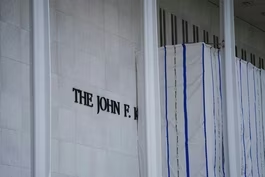
Officials at the Kennedy Center are warning of certain fiscal collapse unless President Trump's name is added to the exterior of the building.
The warning is laid out in a new court filing in the lawsuit brought by Democratic Congresswoman Joyce Beatty, an ex officio member of the Kennedy Center board who has been fighting the effort to put Mr.
Trump's name on the building.
The president's handpicked board is set to meet tomorrow to consider 10 possible inscriptions bearing his name.
The board says that, without what it calls appropriate recognition, Mr.
Trump is unlikely to help lead the fiscal rescue of the center.
Several state election officials tell the "News Hour" they are bracing for uncertainty over mail-in ballots ahead of this year's midterms, but pushed back on recent headlines suggesting chaos over the rules.
That's as the U.S.
Supreme Court is set to rule on President Trump's executive order seeking to restrict mail-in voting.
Late last night, a second federal judge blocked the order, warning it could increase the risk that some valid mail-in ballots go uncounted.
And the timing is critical.
At least three states have already started sending ballots, with some military and overseas ballots set to go out later this week.
Turning now to the war in Ukraine, NATO Secretary-General Mark Rutte condemned Russia's attacks near Ukraine's border with Poland today.
A Russian drone struck a train in Western Ukraine this weekend shortly after several European officials had passed through.
The E.U.
's top diplomat said today the attacks were meant to scare Western countries from supporting Ukraine.
And speaking in Brussels, Rutte said the strikes show that Russian President Vladimir Putin is -- quote -- "desperate" and that the NATO alliance is solid.
MARK RUTTE, NATO Secretary-General: He thinks that he can stop us from supporting Ukraine and that he can undermine our unity.
He is wrong.
Our answer is to increase support to Ukraine so it has what it needs to defend itself.
GEOFF BENNETT: Also, today President Trump posted on social media that both Ukraine and Russia had agreed to stop attacking each other's energy targets, though he did not provide any specifics.
A Kremlin spokesperson says Moscow welcomes the idea, but also said Russian forces will continue their strikes across the entire territory of Ukraine.
And Ukraine's leader, Volodymyr Zelenskyy, says his country has pushed for such a proposal, but adds that Ukraine is not convinced that Russia would adhere to any agreement.
The National Weather Service is warning of possible flooding across parts of the Central Plains and the Midwest, even as the Northeast recovers from this weekend's torrential storms.
MAN: Bro, this is nuts.
GEOFF BENNETT: In Northern New Jersey, runners found themselves trudging through water midway through a local half-marathon, while, in Connecticut, cars were fully underwater, barely visible from above.
Officials in one town called it the worst flooding in three decades.
The state's governor blamed what's known as a rain bomb, a phenomenon that is getting worse, in part due to human-caused climate change.
GOV.
NED LAMONT (D-CT): It's how sudden the intense rainfall is, five, seven, nine inches in a very limited period of time.
When air gets warmer, it holds more water.
That's why these rain bombs are more severe.
GEOFF BENNETT: The conditions wreaked havoc on plane and train schedules while emergency crews rescued dozens of people across the region.
No deaths or injuries have been reported.
Officials in Pennsylvania reported a third measles related death this weekend.
Local health officials say the unvaccinated 40-year-old woman lived in a rural area in a county northeast of Pittsburgh.
It's more than 200 miles from the county where Pennsylvania's first two deaths involving measles were reported this year.
Both of those involved infants.
Pennsylvania's Democratic Governor Josh Shapiro and Trump administration officials, including Health Secretary Robert F. Kennedy Jr., have clashed over measles reporting this year.
Wall Street ended lower today as A.I.
stocks struggled.
The Dow Jones industrial average lost about 150 points.
The Nasdaq fell about a half-a-percent.
The S&P 500 also started the week in negative territory.
And fashion designer Bob Mackie has died.
Known as the Sultan of Sequins, Mackie helped define 1970s glamour by dressing countless stars in his signature style, sometimes shimmering and sleek, and other times campy and outrageous.
He created costumes for all 11 seasons of "The Carol Burnett Show," including the iconic "Gone With the Wind" dress, curtain rod and all.
He also worked closely with Cher on her variety shows and crafted some of her most famous red carpet looks.
In 2018, he reflected on his design philosophy.
BOB MACKIE, Fashion Designer: I always try to enhance the image that they already have the people -- that people think of them as.
If you're going to appear on stage, you don't want to come on and say, oh, is that her?
I'm not sure that's her.
You want you want them to say yes.
And that's very important.
You don't try to change anybody.
You just try to make them look better than ever.
GEOFF BENNETT: Over the years, Mackie won nine Emmy Awards and a Tony and was nominated for three Oscars.
Bob Mackie was 87 years old.
Still to come on the "News Hour": the EPA rolls back regulations that limit climate-impacting emissions from power plants; our Politics Monday team examines the latest pressure points ahead of this year's midterms; and comedian Jenny Yang takes her act to an unusual stage, immigrant grocery stores.
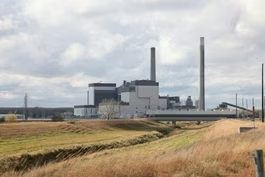
The Environmental Protection Agency announced today it's repealing rules limiting greenhouse gas emissions from coal and gas-fired power plants.
The move eliminates requirements that would have forced some power plants to sharply reduce their emissions, including through technology such as carbon capture and storage.
EPA Administrator Lee Zeldin said the rollback will help cut red tape.
LEE ZELDIN, Environmental Protection Agency Administrator: Our actions result in savings into the trillions of dollars.
It means providing companies that choose to invest in America with the certainty that their work will pay off and their money won't get tied up in unnecessary, burdensome regulatory battles informed more by ideology than practical environmental protection outcomes.
GEOFF BENNETT: Power plants are the nation's second largest source of carbon dioxide and other greenhouse gas emissions.
For more on what this rollback means for U.S.
climate policy, we're joined now by Vickie Patton, general counsel for the Environmental Defense Fund.
Thank you for being with us.
VICKIE PATTON, General Counsel, Environmental Defense Fund: Thank you.
GEOFF BENNETT: So the coal industry has described the Biden era rules as overreach.
You now have the Trump EPA saying that those same rules make it harder and more expensive to generate the kind of power the country needs.
Is there any part of that argument that you accept?
VICKIE PATTON: Today, the Trump administration moved to eliminate any standards, any limitations on the dangerous climate pollution from power plant smokestacks.
I want to be clear.
That is one of the single largest sources of harmful pollution in our country.
It's also a rising source of pollution as communities see increasing data centers.
And if the companies behind those data centers decide to power them with high-emitting power plants, that means that those communities and those neighborhoods and those people are bearing more pollution.
And it's just -- it's not responsible to do nothing in the face of this serious pollution.
It's analogous to your house being on fire and the fire department kind of driving by, instead of taking action.
Look, we're Americans.
We know how to take action to protect our children's health from this harmful pollution and to do it in a way that protects people's pocketbooks with clean, affordable and abundant energy.
So the path forward is not inaction.
The path forward is not reckless irresponsibility.
The path forward is America rolling up its sleeves, working together, and protecting our children's health and growing our economy.
GEOFF BENNETT: The EPA is also making a broader legal argument about whether greenhouse gas emissions can be regulated this way at all.
How significant is that, especially for future administrations?
VICKIE PATTON: You know, the law in the United States for decades has been that EPA has a responsibility under our nation's clean air laws to protect the American people from harmful pollution.
And when you think about kind of the impacts here that are at stake, they're really quite extensive.
The Trump administration was heralding kind of these cost savings.
I want to be very clear that they are assigning no value, no value whatsoever to protecting the American people from the harmful pollution.
Those numbers that they're touting, those are the -- that's the money that large industrial emitters will save in not doing anything to address this harmful pollution.
But the impacts, the impacts are more asthma attacks.
It's more missed work days, missed school days.
It's more hospital visits and doctor's visits.
Look, just this summer, there were heat waves across our country, major fires and smoke that harmed people.
You were just talking about sort of the just really intense weather events, the flooding, and then in parts of the country suffering very serious droughts.
These are really high costs.
And these costs, when we experience them as American people, they mean higher insurance costs.
They mean higher health care costs.
It makes it harder for us to make ends meet.
That's why our nation's clean air laws were designed, to help protect people from pollution.
And it's not the right direction for our country to assign no value to doing that.
And it is the responsibility of the Environmental Protection Agency to move forward and ensure we have limits on this very harmful pollution.
GEOFF BENNETT: But on the question, to what degree could this potentially limit the future -- the ability of a future administration to regulate power plant emissions, because that's in many ways the bigger story here?
VICKIE PATTON: This -- the Trump administration has, in multiple different decisions, including the actions that it's taking today, endeavored to walk away from its responsibility to protect the American people from harmful pollution under our nation's clean air laws.
The law is clear.
It's clear in the written terms of the statute.
It's clear in terms of rulings by the United States Supreme Court, multiple rulings, that EPA has a responsibility to protect the American people from dangerous pollution.
And this pollution is quite dangerous.
It's very serious.
GEOFF BENNETT: If the federal government is no longer requiring these reductions, to what degree could states or local utilities step in?
VICKIE PATTON: States and local governments and local power companies can take all sorts of important actions to address this harmful pollution.
Here, in my home state of Colorado, we found that not only can we move forward together, rolling up our sleeves, we can address this harmful pollution, but we can also do it in a way that benefits people's lives economically.
And so, in rural Colorado, we have seen farmers keep their farms and their families by receiving lease payments to host wind turbines.
In other parts of Colorado, we have seen major employers, manufacturers save hundreds and hundreds of jobs because they're relying on clean, affordable power that's lowered their operating costs.
And so, yes, definitely, states can take action, local governments can take action.
We can all encourage and ensure that our power providers do their fair share.
What we need, though, what we need are these comprehensive national emission limits.
This is a big problem that has very serious impacts on millions of people all across the country, and every American deserves these protections.
GEOFF BENNETT: Vickie Patton with the Environmental Defense Fund, thank you for joining us this evening.
VICKIE PATTON: Thank you so much.
GEOFF BENNETT: A note: The "NewsHour" has requested an interview with the Environmental Protection Agency's Lee Zeldin.
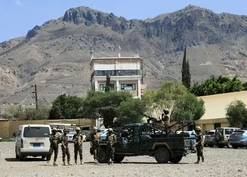
AMNA NAWAZ: Yemen's Houthi rebels seized more islands in the strategically crucial Bab al-Mandab Strait today and now control the west coast of the country on the Red Sea.
In the meantime, a crucial pipeline in Saudi Arabia will be out of commission for weeks after it was attacked last week, sending oil prices even higher.
Here's Ali Rogin.
ALI ROGIN: Today, more Houthis attacks against Saudi Arabia.
Yemeni fighters say they hit Saudi Arabia's Khamis Mushait air base.
And Saudi Arabia says a Houthi projectile wounded two people and damaged a mosque in the Saudi port city of Jazan, just the latest in the past week, with hundreds hurt on both sides of the border and as the conflict reignites.
Riyadh has turned to the U.S.
for help, but, so far, President Trump has not answered a call for American airstrikes.
And over the weekend, he said the U.S.
has been talking to the Houthis directly.
DONALD TRUMP, President of the United States: We have had discussions.
The Houthis called us, and they don't want to fight with us.
They let us know they don't want to fight with us.
They don't want me to go after -- they don't want us to go after them.
And they're letting most ships go through.
This is one country that they're not too happy with, and we will get that straightened out.
ALI ROGIN: Inside Yemen, Houthis seized more islands near the crucial Bab al-Mandab Strait, the choke point through which roughly a 10th of global trade sails.
And so far it has been an advance met with little pushback, capturing more territory without real resistance from Saudi-backed Yemeni forces.
The Houthis have been expanding their control over Western Yemen along the Red Sea.
They're freeing prisoners once held by Saudi-backed forces and celebrating in Sanaa, the Houthi capital.
Today, they expanded their reach again, capturing the islands of Greater and Lesser Hanish, 100 miles north of the strait, giving them even more leverage over Saudi shipping routes out of the Red Sea.
It follows last week's seizure of the port of Mokha and the island of Mayun inside the strait itself that sparked global alarm over who controls it.
And it matters even more now with Iran and the U.S.
still battling over the Strait of Hormuz.
Saudi-backed Yemeni forces are trying to regroup and fight back.
SULTAN AL-ARADAH, Yemeni Leadership Council (through translator): What happened is a deeply painful event for us, and it stems from reasons that will be thoroughly discussed.
Even the forces that withdrew from one location to another are currently regrouping, God willing, and will return to the battle in one way or another.
ALI ROGIN: A crucial Saudi oil pipeline went down after it was struck last week in an attack Riyadh blamed on Iran-backed militias in Iraq.
It will take weeks to fix.
The kingdom had leaned on that pipeline, 745 miles coast to coast, to move crude away from the blockaded Persian Gulf and out through the Red Sea.
Now that route too is under threat.
The Houthis and Saudis fought a nearly decade-long war that for the last four years had settled into an uneasy cease-fire.
Tensions spiked again in July, when Saudi Arabia bombed a Houthi-controlled airport to stop a plane Saudi officials said was carrying Iranian weapons.
And yet the war resurging threatens yet another humanitarian crisis in one of the most impoverished countries in the world.
Already more than 85,000 people have been displaced inside Yemen since July.
More than 2,000 have already crossed the strait by boat to Djibouti, families with their children displaced again and again in this war arriving with nothing.
For the "PBS News Hour," I'm Ali Rogin.
To help us better understand the state of play in this volatile region and how it might affect the wider war, I'm joined now by Michael Ratney, who served as U.S.
ambassador to Saudi Arabia during the Biden administration.
He's now a senior adviser at the Center for Strategic and International Studies.
Ambassador Ratney, welcome back to the "News Hour."
Thanks for joining us.
MICHAEL RATNEY, Center for Strategic and International Studies: Thank you.
ALI ROGIN: As the Saudis deal with these new attacks, what is it exactly that they're asking for from the United States?
MICHAEL RATNEY: So the Saudis are now under direct attack from their mortal enemies, from the Iranians directly, from Iranian proxies, obviously the Houthis, you were discussing, in Yemen, and from Iranian-backed militias in Iraq.
And they're looking for help from the United States, substantial military support, to help try to push back, disincentivize, at a minimum, the Houthis from continuing these attacks and if possible to vanquish them completely.
ALI ROGIN: The Saudis, though, were engaged in a long war with the Houthis for about a decade, bombed them heavily using American munitions, killing many, many Houthis, and yet that still hasn't seemed to really put them on the back foot.
What would the United States getting involved at this point really gain the Saudis?
What makes them think it would make any difference?
MICHAEL RATNEY: So it's true.
There was a really unfortunate, long and unfortunate experience with the Saudis pursuing military conflict against the Houthis.
It eventually resulted in a suspension of that and pursuit of diplomacy, including this road map with the Houthis that effectively legitimized them as a governing authority.
And that worked.
That held until after the Gaza war started and the Houthis started attacking U.S.
shipping.
There was another U.S.
effort to support military strikes against the Houthis that President Trump suspended.
I think now the calculation is that the Houthis have attacked Saudi Arabia, their energy infrastructure, their -- an oil refinery in the south of the country that has an impact not just on the Saudi economy, but global oil markets at this point.
And I think what the Saudis want is some kinetic support from the United States to push back on that.
It's an unfortunate situation.
In the past, it's true that military strikes haven't worked.
And, frankly, I think, eventually, this is headed for diplomacy again.
But, in the meantime, it's hard for the Saudis not to try to retaliate.
ALI ROGIN: So far, President Trump seems to suggest that such support is not forthcoming.
He said: "The Houthis called us.
They don't want to fight with us," as we mentioned in the piece.
He also said he spoke with Saudi Crown Prince Mohammed bin Salman, who says -- and the president says that everything is going fine and will work out dandy.
How do the Saudis feel about how the United States is treating this conflict?
MICHAEL RATNEY: So, at a minimum, they're extraordinarily frustrated.
When you think about it, the Saudis have pursued a military partnership with the United States for decades, and we with them.
And the whole point of a partnership like that is, at a time of crisis, when you're being attacked, you want support from your partner, from your ally.
The Saudis went so far as to pursue a mutual defense treaty with the United States and the possibility of normalization with Israel.
That's how important it was that they have clarity about their relationship with the United States.
I think that's what they're asking for from -- what they're asking President Trump for at this point is military support, and, if not military support, some manner of support that will help them retaliate, push back, disincentivize the Houthis from continuing these strikes.
It seems like President Trump, as you say, is not that interested in doing it.
He probably sees it as kind of broadening a war that he's hoping has wound down already.
But, at this point, it clearly hasn't wound down, and it probably irritates the Saudis to no end to hear President Trump in Ireland talking about this whole war as a small problem that's something we will be very happy with.
ALI ROGIN: Well, and to that point about trying to wind down this wider war, to what extent do you think the U.S.
is staying out of it because they're already overextended in Iran?
MICHAEL RATNEY: You know, that's part of it.
I think it's true President Trump seems to have a lot of calculations for the Iran war.
He seems to want to get out of it.
He seemed to want to get out of it almost since it first started.
Clearly, one of the problems is that the supply of our most sophisticated munitions is being diminished.
Our Navy is being stretched in.
These deployments are long.
It's having an effect on the U.S.
military's posture at a time when there's other conflicts in the world.
So I think he's probably hearing from military leadership that they can't afford another front.
And for him too, politically, I think he's at a point where he doesn't want to have to keep answering questions about why this war keeps going on and on.
ALI ROGIN: In about 30 seconds we have left, how severely do you think this is going to impact oil markets, given the disruptions already that are taking place in the Strait of Hormuz?
MICHAEL RATNEY: I have the impression that, until very recently, global oil markets were not pricing in the risk that was out there.
I think in some ways, they were hopeful, looking for the next cease-fire, looking for the next kind of piece of evidence that this war was over.
I think now you're seeing the real risk being priced in, closure not just of Hormuz, but potentially the Bab al-Mandab, these Red Sea routes, bombing of Saudi East-West Pipeline.
Now you're seeing oil up near $110, and I think that is a result of all of the risk that's finally being recognized.
ALI ROGIN: Former Ambassador Michael Ratney, thank you so much for your insights.
MICHAEL RATNEY: Any time.
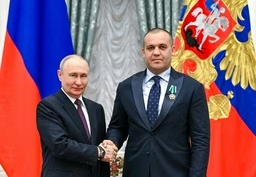
GEOFF BENNETT: A new report from ProPublica says a Russian oligarch with ties to President Vladimir Putin helped fund Donald Trump Jr.
's lavish wedding celebration in the Bahamas earlier this year.
Here with more on this is our White House correspondent, Liz Landers.
LIZ LANDERS: According to the report, Umar Kremlev, a Russian businessman and president of the International Boxing Association, paid hundreds of thousands of dollars in expenses for the president's son's wedding weekend, including the rental of a private island and a fireworks display.
Joining us to discuss his reporting is Justin Elliott, one of the team of journalists investigating the story for ProPublica.
Justin, thank you for joining us.
JUSTIN ELLIOTT, ProPublica: Good to be here.
LIZ LANDERS: How did you trace this money to this Russian oligarch?
What did you find in your reporting?
JUSTIN ELLIOTT: Yes, so we talked to a lot of people that -- both in Donald Trump Jr.
's world and in the oligarch's world, and we ultimately reviewed records and talked to people who had intimate knowledge of this, of these payments.
We found -- we don't have the exact number, but we know that well into the six figures was spent in wedding payments for Donald Trump Jr.
And after the story was published, Bettina Trump, Donald Trump Jr.
's new wife, made a post on Instagram confirming that Umar Kremlev had paid for the wedding and describing him as a personal friend.
LIZ LANDERS: I want to ask about that.
So she said in a statement on Instagram today that their wedding was on a Friday, that they were surrounded only by family, and that friends came for the weekend to celebrate.
She added -- quote -- "Our dear friend Umar very generously hosted two incredible nights of celebrations for us after our wedding.
It was an extraordinarily generous wedding gift from a friend, and something for which we were and remain incredibly grateful."
What's your response to her explanation?
What do you make of that?
JUSTIN ELLIOTT: Yes, I mean, it's consistent with our reporting.
This was a three-day wedding.
The actual wedding ceremony was on the Friday.
As she says, that was just family, and then this larger group of around 50 guests were there for the sort of two days of partying, which is what Kremlev paid for.
I think the thing that really still has not been fully explained is how this Russian oligarch who by their own account met Donald Trump Jr.
only a couple of years ago ended up paying hundreds of thousands of dollars at least in wedding expenses.
It's just not a situation that any of us had ever heard of a kind of new friend paying for your wedding.
LIZ LANDERS: What else did you find about the relationship between Don Jr.
and Kremlev?
And what did Umar Kremlev say about why he funded this?
JUSTIN ELLIOTT: So we actually found very little about the relationship between Donald Trump Jr.
and Umar Kremlev.
For one thing, we have talked to a lot of people that have worked with Kremlev over the years and we're told very consistently that he speaks limited English.
I think the thing that we were very fixated on is that he's not just a random businessman.
He is somebody that has very close connections to the Russian government, owes a lot of his wealth to the direct interventions of the Russian government, and is in President Vladimir Putin's circle.
And so we talked to a lot of both Republican and Democratic former FBI counterintelligence officials, who said that, if they'd heard about this sort of thing when they were in the government, it would have been a sort of five-alarm situation, where they would have been warning the family member of the president, in this case, Donald Trump Jr., that, look, this person may have other motivations besides just friendly generosity.
In terms of what Kremlev said, Kremlev's spokesperson actually didn't address our questions about why he had paid for this, beyond saying that they were friends who had met a couple of years ago.
LIZ LANDERS: We should mention that President Trump did not attend this wedding, but Jared Kushner, who is negotiating on behalf of the U.S.
government with this Ukraine-Russia conflict, he was there.
What more do we know about who Kremlev is and his relationship with Putin?
JUSTIN ELLIOTT: Yes, I mean, it's interesting.
One of the things we learned actually is that is that, just a few days before the wedding in the Bahamas, Kremlev was actually in China as part of President Putin's official delegation to China.
Putin was in China at the same time.
We also know he's gotten several awards from Putin as recently as this past April.
I think he received the Order of Friendship.
It's an important award given out by the Russian government.
And I think, sort of most of all, Kremlev's fortune, he owes to the Russian government.
I mean, for example, he owns the largest car dealership company in Russia, and that was a company that was previously nationalized, and then the government announced that Umar Kremlev was the new owner.
Again, he's not just a random businessman.
He's somebody that has very close connections to the Russian government.
And as one of the former FBI officials who we spoke to said, his concern was, if somebody pays for your wedding, at some point, you're going to owe them something.
LIZ LANDERS: Donald Trump Jr.
is worth around $300 million, according to a recent estimate from Forbes.
Why didn't he just pay for this himself?
JUSTIN ELLIOTT: You know, that's a good question.
I mean, I have heard of the bride's family paying for the wedding.
I have never heard of a situation of a friend, and certainly not a sort of recently acquired friend, paying for a wedding.
We don't have full insight into Donald Trump Jr.
's wealth.
How much of his multihundred-million dollar fortune is actually liquid, ready to spend, I don't know, or maybe it's just a hard thing to refuse if somebody's offering to foot the bill for -- a lot of the bill for this very expensive weekend.
So they -- Donald Trump Jr.
's people did not comment on that.
The statement that they released after our story did not comment on this, besides saying that they were very grateful for what they described as a very, very generous gift.
LIZ LANDERS: Justin Elliott, thank you so much for sharing your reporting.
JUSTIN ELLIOTT: Thanks so much.
AMNA NAWAZ: For more on how Washington is responding to A.I.
and other issues shaping midterms races, we turn now to our Politics Monday duo.
That is Amy Walter of The Cook Political Report With Amy Walter and Tamara Keith of NPR.
It's great to see you both.
AMY WALTER, The Cook Political Report: Hello.
TAMARA KEITH, National Public Radio: Good to be here.
AMNA NAWAZ: Let's start with these growing concerns over A.I., what might actually be done to address them.
We reported earlier President Trump says he does not want to see more regulation.
House Speaker Mike Johnson has said tech companies should take the lead.
As you have seen, this issue is making for some strange alliances, Steve Bannon, Bernie Sanders now finding themselves on the same side of this issue.
Congress is back in session, Tam, as you know, but we have also -- we want to note Senator Mitch McConnell is back on the Hill tonight for the first time after a three-month absence due to health issues.
That's him there in the wheelchair at the bottom of your screen.
But, Tam, this is lawmakers' final week before the midterms.
Are they going to do anything when it comes to A.I.?
TAMARA KEITH: Probably not in any serious way that will become law, because I will just point out that Facebook has been around, social media has been around since the mid-2000s, and many of those companies in a previous life were begging Congress to regulate them, to create guardrails, to create rules of the road.
And you know what happened?
Nothing.
Right now, there is some bipartisan agreement when it comes to social media to protecting children.
And yet they have not been able to get any legislation over the finish line.
And now we're talking about a new technology that -- where the U.S.
would like to have a competitive advantage, where there's a real collective action problem, a lot of money at stake.
And then you see this division between -- there are actually a lot of rank-and-file Republicans who are hearing from their constituents like, hey, we're worried about A.I.
data centers, we're worried about A.I.
taking our jobs, we're concerned about these things, and then the president of the United States, who is essentially saying you're going to be a backwards loser if you are concerned about A.I.
or don't want a data center in your backyard.
AMNA NAWAZ: Amy, these fears, though, that we're hearing from tech leaders, they are new, they are different.
Is this the kind of thing voters are paying attention to?
AMY WALTER: This still is an affordability election.
That's what voters say over and over again their top concerns are.
And in that way, it's -- the data centers are part of the affordability conversation.
What we're seeing in campaign ads, what we're hearing on the campaign trail are candidates saying, either look at me, I'm here to help regulate the data centers to ensure that your electricity bills do not go up or to bring the cost of your electric bills down, or, better yet, to blame your opponent for the high cost of electricity because they OKed data centers and gave them tax breaks.
But the degree to which the actual topic of A.I.
and its influence, these concerns about it breaking out of its sandbox and its impact is not yet something that we're hearing candidates talk about.
And, quite frankly, the midterm elections probably aren't the place for it to happen.
Where it will, I think, become a very big topic, and topic number one will be once we get into the presidential race.
AMNA NAWAZ: How about how closely voters are paying attention to some of the other stories we're covering right now, the one Liz was reporting on earlier, the revelations from the ProPublica investigation that showed Don Trump Jr.
's wedding celebration was substantially bankrolled by a Russian oligarch with close ties to Putin?
And Trump Jr.
and his wife confirmed the funds.
They called it a wedding gift.
Do Americans see that, these conflicts as problematic, or have they just become normalized?
AMY WALTER: Well, I think that what Americans believe is politics is corrupt and they have very little faith in actually most institutions.
But, in politics, it's being able to make the link between corruption and the cost to you.
What does it mean for a political system or person to be corrupt?
It means that you're paying more or getting less.
That is the connection.
We're seeing that conversation happening in campaigns.
So it's not that corruption doesn't matter, but, for voters, they do have to see how this is impacting them.
AMNA NAWAZ: And the appearance of the impropriety used to be enough to prevent the behavior.
Are the guardrails just totally gone?
TAMARA KEITH: There are not a ton of guardrails, though I think voters can be the ultimate guardrail.
We saw in the 2006 blue wave that there were a lot of concerns from voters about scandal among Republicans.
Well, so, this election, we are seeing that corruption is a big concern.
It's actually a bipartisan concern.
And the general feeling among -- voters are very cynical.
And the general feeling is that the political class is getting ahead, while regular people are struggling to get by, their gas costs more, their groceries cost more, and they're just struggling to make it.
And then these guys can just get rich, which is why you see some candidates talking about the ban on stock trading for members of Congress.
You actually see candidates from both sides of the aisle doing this.
You do see a lot of discussion of corruption.
But, obviously, it varies by party how they're directing it.
And there just isn't that much focus on Trump and his family in sort of paid advertising.
AMNA NAWAZ: I do want to turn now to where we're going to find the president and the vice president both today and the rest of the week.
Vice President Vance, we should point out, is in Kansas tonight.
He's stumping for Senator Roger Marshall, who's seeking a second term there against the Democrat Adam Hamilton.
President Trump himself will be in North Carolina later this week.
He's hoping to boost Michael Whatley's Senate campaign there against the former Democratic Governor Roy Cooper.
Tam, what does it say to you about those races, the fact that the vice president and president are on the ground for these candidates?
TAMARA KEITH: Yes, so the vice president is there in Kansas.
I will say that it's much cheaper to send the vice president to Kansas, especially when there's like an official visit attached to it, than it is to drop a few million on TV ads.
At this point, we are not seeing MAGA Inc.
or any of the other big groups dropping money in Kansas, but this is a signal that they have their eyes on it and they want to help, at least a little bit.
North Carolina is a race.
I mean, actually, it's not really a race at this point.
Roy Cooper is polling much - - in a much better place than Michael Whatley.
Michael Whatley is someone who Trump feels something of a debt to because he was the chair of the Republican National Committee.
He's also the person that President Trump wanted running in that Senate seat, and Whatley has had something of a lackluster campaign.
AMNA NAWAZ: Amy, how are you looking at this?
AMY WALTER: I mean, the fact that these are two very different states and yet they're both on the board tells you a lot about this election season.
And they're on the board for different reasons, but also one thing that they both have in common is a lack of enthusiasm from the Republican base.
Obviously, the president spent a good deal of time last week -- Tam was there in Dallas -- telling his base, come and vote, pretend I'm on the ballot.
AMNA NAWAZ: That was at the midterm convention in Dallas, yes.
AMY WALTER: That was at the midterm convention.
But the challenge the president has with his base is that the ones who are saying they are the least enthusiastic about showing up also happen to be the ones who are most stressed about the economy, who believe that the president isn't doing a particularly good job on handling the economy.
And so when you bring out the president to a place like North Carolina, the vice president to Kansas, they are speaking to the base.
They are not really trying to speak to the swing voters who, quite frankly, are in North Carolina more so than they're in Kansas.
AMNA NAWAZ: Fifty days to go until those midterms.
AMY WALTER: Yes.
(CROSSTALK) AMNA NAWAZ: Amy Walter, Tamara Keith, great to see you both.
Thank you.
AMY WALTER: You're welcome.
TAMARA KEITH: You're welcome.
GEOFF BENNETT: As the challenges facing immigrant communities continue to make headlines, Los Angeles-based comedian and writer Jenny Yang is taking a different approach, using comedy to draw attention to the issues on her nationwide stand-up tour.
Senior arts correspondent Jeffrey Brown caught up with her for our series Art in action, exploring the intersection of art and democracy, which is part of our Canvas coverage.
JEFFREY BROWN: Why are why are we here, Jenny?
JENNY YANG, Comedian: We're here because, why not?
Jeffrey, why not?
JEFFREY BROWN: It's not a normal spot for an interview... JENNY YANG: There might be some box-moving around here.
JEFFREY BROWN: ... in the aisles of a grocery store in New York's Chinatown.
Look what we have got.
JENNY YANG: We got wife cake.
JEFFREY BROWN: Wife cake.
JENNY YANG: We got mooncake.
We got -- so I don't know.
For me, it's like what's more joyful than my people's food.
JEFFREY BROWN: Jenny Yang is taking her comedy into some unusual places, like here at the New Kam Man Market, part of her Good Egg Immigrant Grocery Store Stand Up Comedy Tour.
You could be crying in H Mart.
JENNY YANG: But you're laughing at New Kam Man Market, baby.
JEFFREY BROWN: For Yang, who was born in Taiwan and moved to the U.S.
with her family as a child, the comedy is a serious response to the Trump administration and its policies around immigration.
JENNY YANG: I have felt a deep sense of anger and hopelessness.
And so for me to get some hope into my veins, I was like, what if I actually go to where the people are and witness myself, how are people living right now?
I decided I'm going to tour the country inside immigrant grocery stores and raise money for local immigrant organizations that are protecting our communities.
Why not?
Why not?
JEFFREY BROWN: The tour started with stores in just a handful of cities, but grew to nearly 20.
JENNY YANG: These ICE raids have created a second pandemic for people.
It's created a sense of isolation, of fear.
And so I think for me to come to immigrant grocery stores to say, no, this is our space, and we can reclaim it, we can have joy in it, we can laugh in it, we can grab snacks and drinks that we love, that kind of physical, visceral experience is what I love about art and comedy.
JEFFREY BROWN: Yang, who spent several years as a labor organizer before becoming a comedian, appeared alongside Michelle Yeoh in the Netflix action series "The Brothers Sun."
She wrote for TV shows like Fox's "Last Man Standing" and "Busy Tonight" on E!
In 2016, Yang was recognized by the Obama administration for her contributions to Asian American and Pacific Islander art and storytelling.
JENNY YANG: I can write jokes about immigration policies.
I have done topical jokes, but that's not my personal comedy.
JEFFREY BROWN: But it almost sounds like the personal is political in this sense.
JENNY YANG: A hundred percent.
JEFFREY BROWN: Yes.
JENNY YANG: Jeffrey knows what's up.
JEFFREY BROWN: Yes.
JENNY YANG: My art is not just what I say on stage.
My art is in the practice of how I do my touring, of how I put together my work, of who I hire to do my art, you know?
So, going to a grocery store, connecting with the immigrant grocery store owner, of benefiting a local organization that might help with people who've been impacted by the immigration policies, that in and of itself is, like, part of my art.
JEFFREY BROWN: Shows are deeply personal, one bit, the challenges of growing up the child of immigrants.
JENNY YANG: I would best describe my immigrant parents' style, parenting style, as frazzled CEO.
(LAUGHTER) JENNY YANG: OK, because how do you mean a micromanager and neglectful at the same time?
JENNY YANG: How do you do that?
How do you do that?
JEFFREY BROWN: The grocery store setup keeps crowds small, sometimes fewer than 100 people.
The Good Egg title is a nod both to her rule-following personality... JENNY YANG: I am what you call a recovering try-hard.
If you did not laugh at that or nod, you are the slackers that are mooching off of us.
JEFFREY BROWN: ... and her struggles with fertility, including 10 failed rounds of in vitro fertilization.
JENNY YANG: I think we need to do a photo shoot for my pregnancy failures.
JEFFREY BROWN: What do you want from the audience?
Because you are taking us to some dark places.
JENNY YANG: Yes.
I want people to laugh and to think about the stories I tell them long after they leave my show.
I want them to reflect on how they might be a little more emboldened to be more themselves.
Part of my authenticity involves being transparent around the things that I struggle with and not having to sort of put up this facade and this mask that I just have everything together, which is what a lot of people rely on.
We all are walking around just pretending we're OK.
Jeffrey, we are not OK.
This is how every comedy show should begin.
JEFFREY BROWN: In July, she performed at the Shuang Hur Supermarket in Minneapolis, which became the epicenter of the Trump administration's immigration crackdown earlier this year.
JENNY YANG: I can't talk about Minneapolis without tearing up.
It was very important for me to go to Minneapolis, because Minneapolis has been the source of so much heartache.
It was symbolically meaningful.
As an experience, it was meaningful for me to get to know how they coped, how they have adapted, how they survived.
The owner of that supermarket felt more safe than some of his Black and brown customers who didn't want to show up into the streets.
So he went and delivered groceries.
Stories like that make me believe in humanity again, Jeffrey.
And that's why I toured.
I just want to be amongst the liquid gold.
JEFFREY BROWN: Early next year, Yang will record her first one-hour comedy special at, where else, an immigrant grocery store in her hometown of Los Angeles.
JENNY YANG: Any comedian who wants to do a one-hour special, all they need is stage time.
So it doesn't matter if it's in a comedy club or a theater.
For me, I'm like, if I could bring the people to an immigrant grocery store, that's stage time.
That's the show, everyone.
Thank you so much.
JEFFREY BROWN: For the "PBS News Hour," I'm Jeffrey Brown at the New Kam Man in New York.
AMNA NAWAZ: And that is the "News Hour" for tonight.
I'm Amna Nawaz.
GEOFF BENNETT: And I'm Geoff Bennett.
For all of us here at the "News Hour," thanks for spending part of your evening with us.

AI leaders fuel calls to rein in rapidly advancing tech
Video has Closed Captions
Trump pushes back as AI leaders fuel calls to rein in rapidly advancing technology (8m 34s)
EPA repeals regulations limiting power plant emissions
Video has Closed Captions
EPA repeals limits on greenhouse gas emissions from power plants (7m 17s)
Houthi gains, Saudi pipeline attack pressure oil markets
Video has Closed Captions
Houthi gains in Yemen, attack on Saudi pipeline compound pressure on oil markets (9m 36s)

Jenny Yang takes act to stages in immigrant grocery stores
Video has Closed Captions
Comedian Jenny Yang takes act to stages inside immigrant grocery stores (6m 15s)
News Wrap: Kennedy Center warns of 'fiscal collapse'
Video has Closed Captions
News Wrap: Kennedy Center warns of 'fiscal collapse' without Trump's name on building (5m 59s)
Russian oligarch paid for Trump Jr.'s wedding celebrations
Video has Closed Captions
Putin-tied Russian oligarch paid for Trump Jr.'s wedding celebrations (6m 25s)
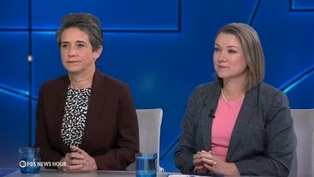
Tamara Keith and Amy Walter on Washington's response to AI
Video has Closed Captions
Tamara Keith and Amy Walter on Washington's response to AI and data center concerns (8m 7s)
Providing Support for PBS.org
Learn Moreabout PBS online sponsorship New Episode
- News and Public Affairs

Today's top journalists discuss Washington's current political events and public affairs.

- News and Public Affairs

FRONTLINE is investigative journalism that questions, explains and changes our world.
 New Episode
 New Episode
 New Episode
 New Season
 New Episode
 New Episode

 New Episode
 New Episode
Support for PBS provided by:
Major corporate funding for the PBS News Hour is provided by BDO, BNSF, Consumer Cellular, American Cruise Lines, and Raymond James. Funding for the PBS NewsHour Weekend is provided by...