
How tech firms are replacing traditional defense contractors
Clip: 10/1/2026 | 7m 32sVideo has Closed Captions
'Valley of Death' reveals how tech companies are replacing traditional defense contractors
Efforts to reshape the military include modernizing the technology soldiers will use on the battlefield and the further integration of artificial intelligence. Some of the biggest names in Silicon Valley are working with the Pentagon and cashing in. Amna Nawaz discussed more with Sharon Weinberger, author of "Valley of Death: How Big Tech Is Fueling the Future of War."
Problems playing video? | Closed Captioning Feedback
Problems playing video? | Closed Captioning Feedback
Major corporate funding for the PBS News Hour is provided by BDO, BNSF, Consumer Cellular, American Cruise Lines, and Raymond James. Funding for the PBS NewsHour Weekend is provided by...
How tech firms are replacing traditional defense contractors
Clip: 10/1/2026 | 7m 32sVideo has Closed Captions
Efforts to reshape the military include modernizing the technology soldiers will use on the battlefield and the further integration of artificial intelligence. Some of the biggest names in Silicon Valley are working with the Pentagon and cashing in. Amna Nawaz discussed more with Sharon Weinberger, author of "Valley of Death: How Big Tech Is Fueling the Future of War."
Problems playing video? | Closed Captioning Feedback
Where to Watch PBS News Hour
PBS News Hour is available to stream on pbs.org and the PBS app.
Providing Support for PBS.org
Learn Moreabout PBS online sponsorshipAMNA NAWAZ: Efforts to transform the military include modernizing the technology that soldiers use on the battlefield and the further integration of AI.
For perspective on how the biggest names in Silicon Valley are reshaping the Pentagon and cashing in, I spoke with Sharon Weinberger, author of the new book "Valley of Death: How Big Tech is Fueling the Future of War."
Sharon Weinberger, welcome to the "News Hour."
Thanks for being here.
SHARON WEINBERGER, Author, "Valley of Death: How Big Tech is Fueling the Future of War": Thanks for having me.
AMNA NAWAZ: So your book really documents how deeply bound and intertwined the U.S.
government is with what you call the arsenal of the broligarchy.
I love this term.
What does that mean?
Who does that -- who comprises that broligarchy, as you put it?
SHARON WEINBERGER: So it refers broadly to the entrepreneurs, the investors, the CEOs that are part of this new wave of defense company out of Silicon Valley.
And when I say Silicon Valley, it's not just the geographic area.
It's the whole ecosystem of Silicon Valley.
AMNA NAWAZ: You talk about how Silicon Valley has basically come to replace or supplant what used to be sort of the industrial -- military-industrial complex that was previously defined by really big defense contractors working with the government.
How did that shift happen?
SHARON WEINBERGER: So it's happened in a couple fronts.
So we still have what are called the five primes.
These are the large defense companies that people have probably heard of, Northrop Grumman, Lockheed, Boeing, and the others.
But what has happened is you now have these new companies, again, out of Silicon Valley who are becoming part of those primes, meaning they're handling large contracts, they're contracting directly with the Pentagon.
How that happened really goes back to two companies, SpaceX and Palantir, that came out of the PayPal mafia around 2003-2004 and fought very, very hard and rather successfully to break into the Pentagon market.
AMNA NAWAZ: You talk about the PayPal mafia.
Who are you talking about here?
Because a lot of these companies are incredibly powerful and people don't know who's behind them.
SHARON WEINBERGER: So the PayPal mafia is a number of the people who were high-level in PayPal, but in this case it was Elon Musk, who founded SpaceX in 2003, and then Peter Thiel, who around that same time founded Palantir along with Alex Karp, two names that people now recognize.
AMNA NAWAZ: One of the biggest trade-offs in this new system seems to be that it's big tech investing its own money in the development and in the production.
What does that mean for who has a say in how these systems get used when you're talking about defense systems for the U.S.
government?
SHARON WEINBERGER: So that's the biggest shift that has happened.
One thing is, people will say, well, we have had defense industry for a long time, since World War II, and the standing armaments industry that President Eisenhower talked about.
But the big difference is, is that during the Cold War and even up until today, the weapons that those companies developed were paid for and in fact ordered up by the Pentagon, by the U.S.
government.
So you don't have the Pentagon or the secretary of defense or war calling the CEO of Lockheed Martin saying, may I use your F-35 for this military operation?
So a lot of the technologies that these Silicon Valley firms developed, they used their own money, venture money, private capital money, and they own the underlying technology.
And so what that means is, in the case of Elon Musk, as we saw during the early days of the Ukraine war, the satellite Internet system was the backbone of the Ukrainian military.
They asked if they could use it for an operation in Crimea, and Musk said no.
And this sort of freaked out the Pentagon that one CEO, one tech billionaire could make decisions on how things were and weren't used.
AMNA NAWAZ: And you meet with venture capitalists, a lot of the folks behind some of these investments.
Is the soldier, are the troops who are on the front lines of a lot of these conflicts that they're designing for and producing weapons for, are they part of the conversation at all?
Is anyone talking about them?
SHARON WEINBERGER: So, sort of.
I mean, the sad part is, that's the conversation in part that should be happening.
Are these technologies really better?
The one thing I will say, perhaps not in defense of these new companies, but I think is important to acknowledge, is, there was a lot of frustration from troops on the ground in places like Afghanistan that their iPhone, their smartphone could do so much more than the technology the military was providing.
And so you had companies like Palantir that actively sort of promoted their technologies, showed their software with soldiers who were deploying to Afghanistan, and that did create some demand, where soldiers were like, oh, this is point and click.
It's kind of what I'm used to.
It's better than what the defense companies are offering.
AMNA NAWAZ: So bring us up to speed in terms of what this means for where we are now.
You saw at the second inauguration of Donald Trump many of these big tech leaders sitting right up there with him on the stage as he was sworn in.
He made it very clear there's going to be close ties between his government and Silicon Valley.
He's also made it clear that he doesn't want any limits or any regulation on the development of artificial intelligence technology.
What does that mean for all of these firms and the relationship with the U.S.
government?
SHARON WEINBERGER: I mean, right now, it's kind of boom times for this industry.
Of the things that people I think were so surprised by at the beginning of the Trump administration was that Silicon Valley, which had the reputation of being to the left, of supporting Democrats, really fell behind Donald Trump.
First Trump administration, Peter Thiel was the outlier supporting Trump.
Second time around, you had all these tech CEOs showing up the White House praising Trump.
And there's two parts of that.
One is that Silicon Valley at the end of the day is going to do what's good for its business.
And if supporting the administration, whether it's Republican, whether it's Democrat, that they're going to do that if they need to.
But the other part is, they genuinely saw an opportunity to shape the administration.
They -- MAGA is not 100 percent behind AI or behind the tech -- behind the tech bros.
But certainly Silicon Valley has done a good job of convincing Trump of their interests, and that's what we're seeing with this push against regulation.
He's doing a lot of the things that Silicon Valley is, frankly, pretty happy about.
AMNA NAWAZ: I mean, at the end of the day, all of this is being done in the name of national security.
Do we know if it's making us safer?
SHARON WEINBERGER: You know, one of the open questions when I started writing the book was, I didn't want to be too harsh, in the sense of Silicon Valley was making big claims.
Silicon Valley tends to make big claims, the fake it until you make it.
But I thought maybe it's too early to really say.
SpaceX has been important.
Palantir, they have certainly modernized software.
They have had some contributions.
But the more and more I reported through the book, especially through the war in Ukraine, and now with military operations in Iran, I'm not buying the argument.
The entire argument of Silicon Valley was, we can contribute to defense.
Let's build.
Let's reindustrialize.
We're more innovative, we move faster, we're cheaper, we have AI.
And yet we're seeing very, very limited examples in the Middle East and in operations in Iran where Silicon Valley is really helping.
If anything, you have seen some indications that some of the AI, the Palantir smart system, may have contributed to errant strikes in Iran.
We're seeing it's -- we're not seeing this miraculous technology solving warfare.
That is what's been pitched.
AMNA NAWAZ: Well, the book is the "Valley of Death: How Big Tech is Fueling the Future of War."
The author is Sharon Weinberger.
Sharon, thank you so much.
SHARON WEINBERGER: Thank you for having me.

Cornell's handling of rape allegations faces more scrutiny
Video has Closed Captions
New details intensify scrutiny of Cornell's handling of gang rape allegations (6m 12s)

Inside the UN peacekeeping mission on Lebanon-Israel border
Video has Closed Captions
On the ground with UN peacekeepers as Lebanon-Israel mission nears its end (7m 39s)

Investigators search for motive after pilot's alleged attack
Video has Closed Captions
Investigators search for motive after alleged attack by FlyDubai co-pilot (5m 58s)

Karl Rove and David Axelrod give their midterm predictions
Video has Closed Captions
Karl Rove and David Axelrod give their midterm predictions (5m 52s)
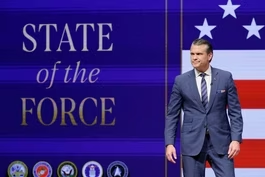
A look at Hegseth's attempts to reshape the Pentagon
Video has Closed Captions
A look at Hegseth's attempts to reshape the Pentagon (6m 22s)

News Wrap: SCOTUS to review mandatory detention for migrants
Video has Closed Captions
News Wrap: Supreme Court to review mandatory detention policy for migrants (6m 6s)

What we know about the botched execution of Christa Pike
Video has Closed Captions
What we know about Tennessee's botched execution of Christa Pike (6m 27s)
Providing Support for PBS.org
Learn Moreabout PBS online sponsorship New Episode
- News and Public Affairs

FRONTLINE is investigative journalism that questions, explains and changes our world.

- News and Public Affairs

Today's top journalists discuss Washington's current political events and public affairs.
 New Episode

 New Episode

 New Episode


 New Episode
Support for PBS provided by:
Major corporate funding for the PBS News Hour is provided by BDO, BNSF, Consumer Cellular, American Cruise Lines, and Raymond James. Funding for the PBS NewsHour Weekend is provided by...